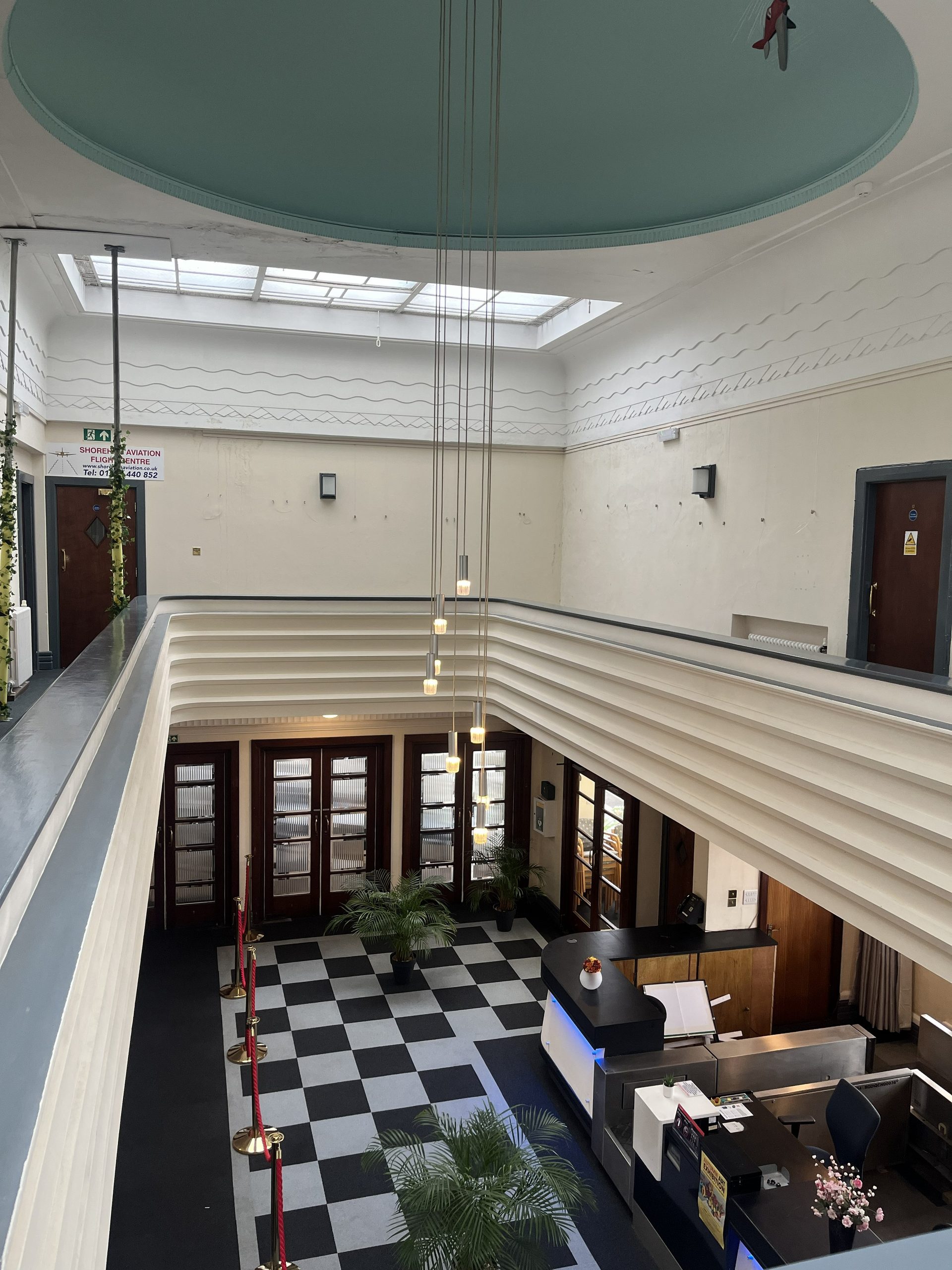
Thursday 3rd September 2026. My 55th birthday is spent exploring Shoreham-on-Sea, West Sussex. Am here mainly to see the Art Deco airport, having been musing on a line that opens one of Douglas Adams’s novels:
It can hardly be a coincidence that no language on Earth has ever produced the expression ‘as pretty as an airport.’
But surely, I thought, some airports are prettier than others. Hence seeking the one at Shoreham, which has been used for Agatha Christie adaptations. It is still operational, but is so small it can only handle helicopters and light aircraft.
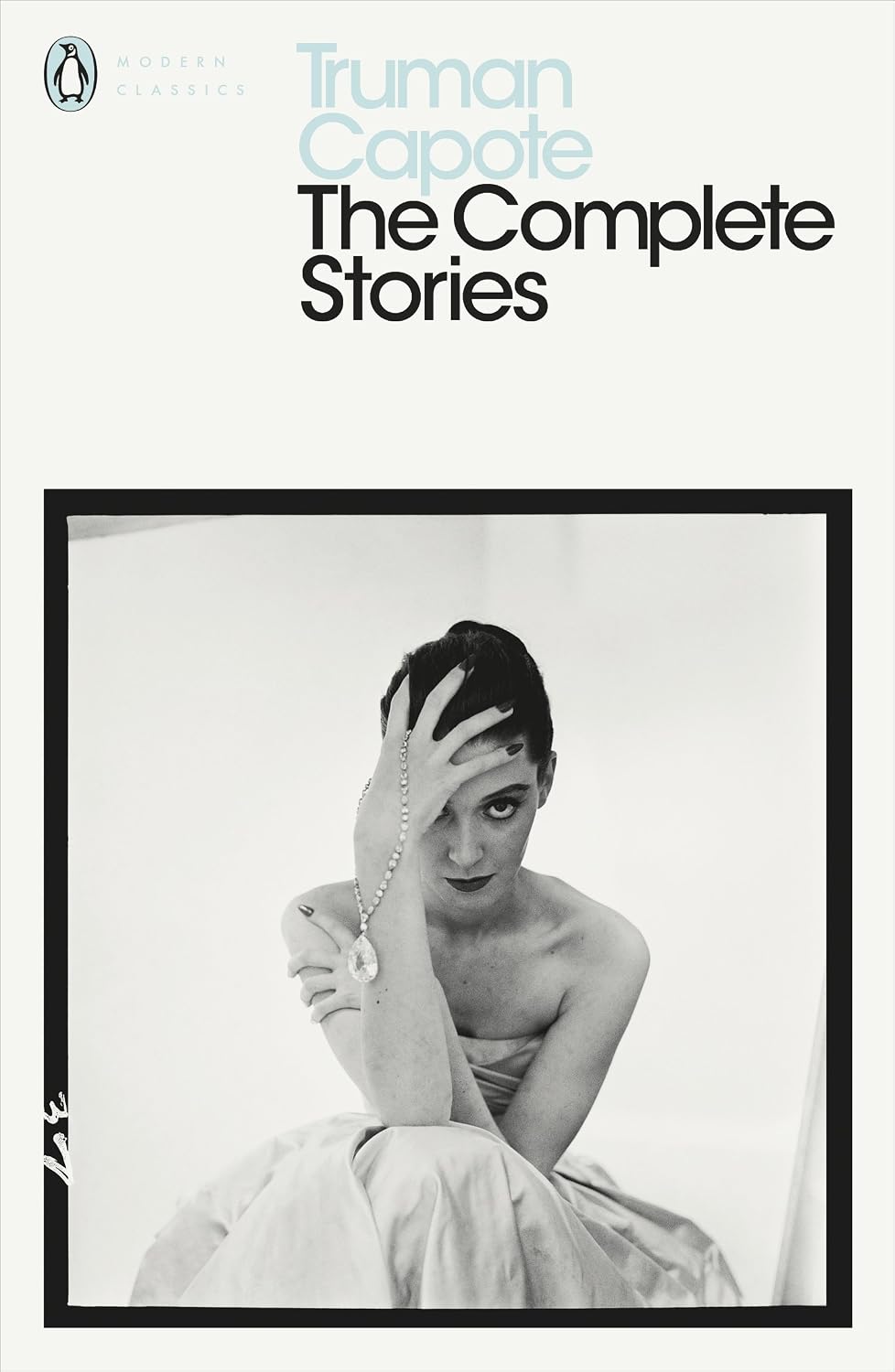
Then to visit the indie bookshop Chapter 34, which is ordered according to its own categories: ‘Dark Matter’, ‘Nostalgic Narratives’, The Self Shelf’. I leave with Percival Everett’s Erasure, Richard Ayoade’s The Unfinished Harauld Hughes, and Truman Capote’s Complete Stories, with its gorgeous Richard Avedon cover.
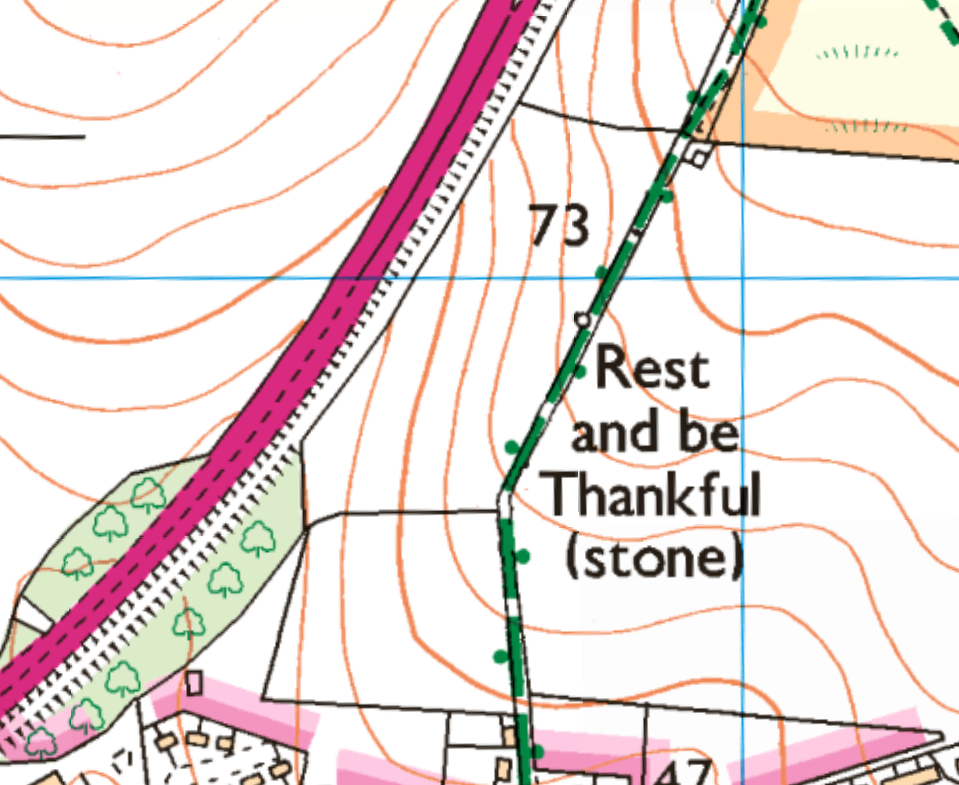
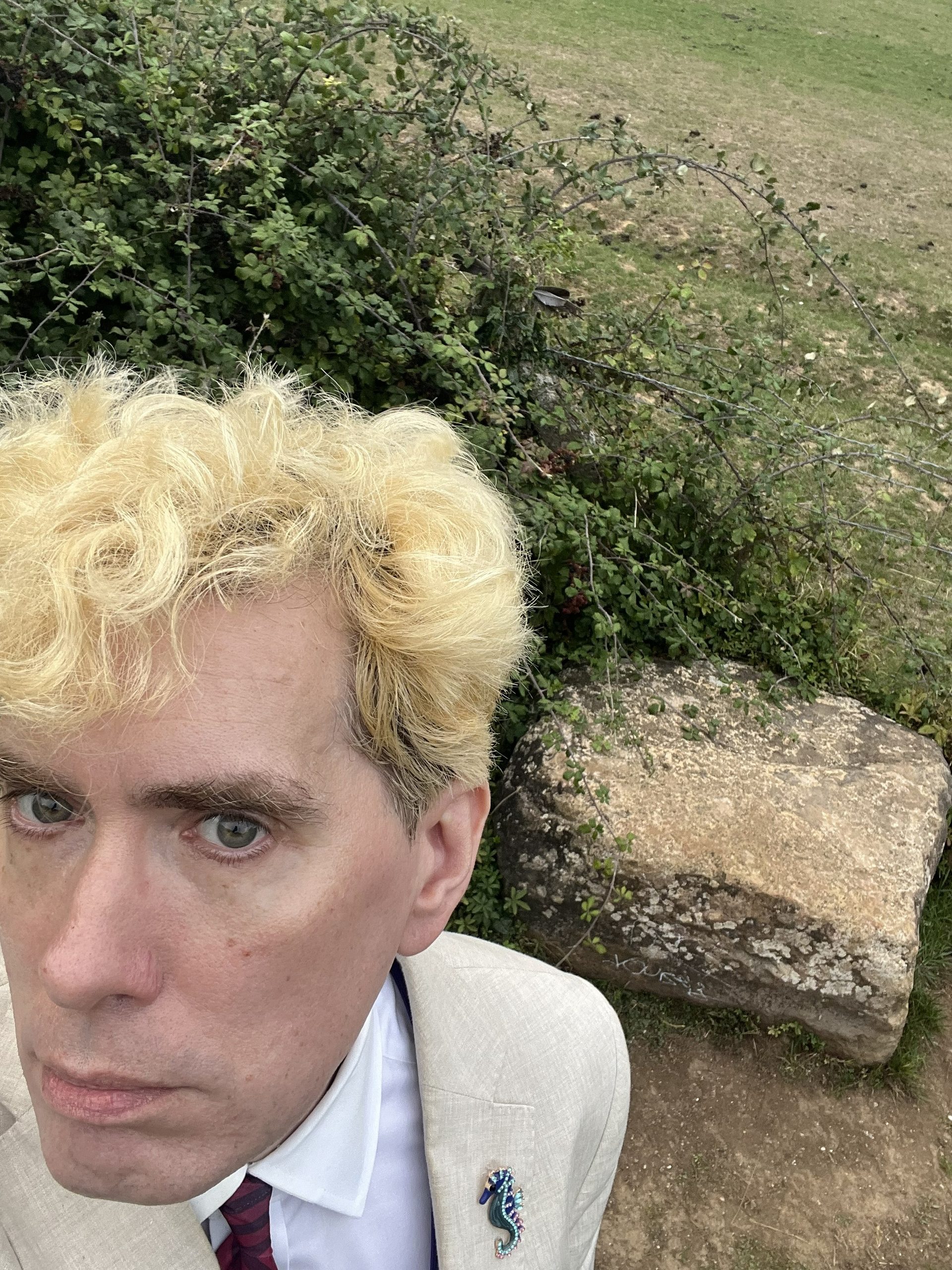
I also seek out the ‘Rest and Be Thankful’ stone, an ancient seat by a footpath, to the north of the Brighton sprawl. I sit on it and am thankful. One can never have too many passive aggressive landmarks.
The local buses have tables on the upper decks, like the ones on trains.
**
Saturday 5th September 2026. To Kings Cross, now described as a ‘lifestyle district’, all bustling and monied and youthful. A man standing by the Wetherspoons bar at St Pancras station shouts “Oh. My. God” as I walk past. Still got it.
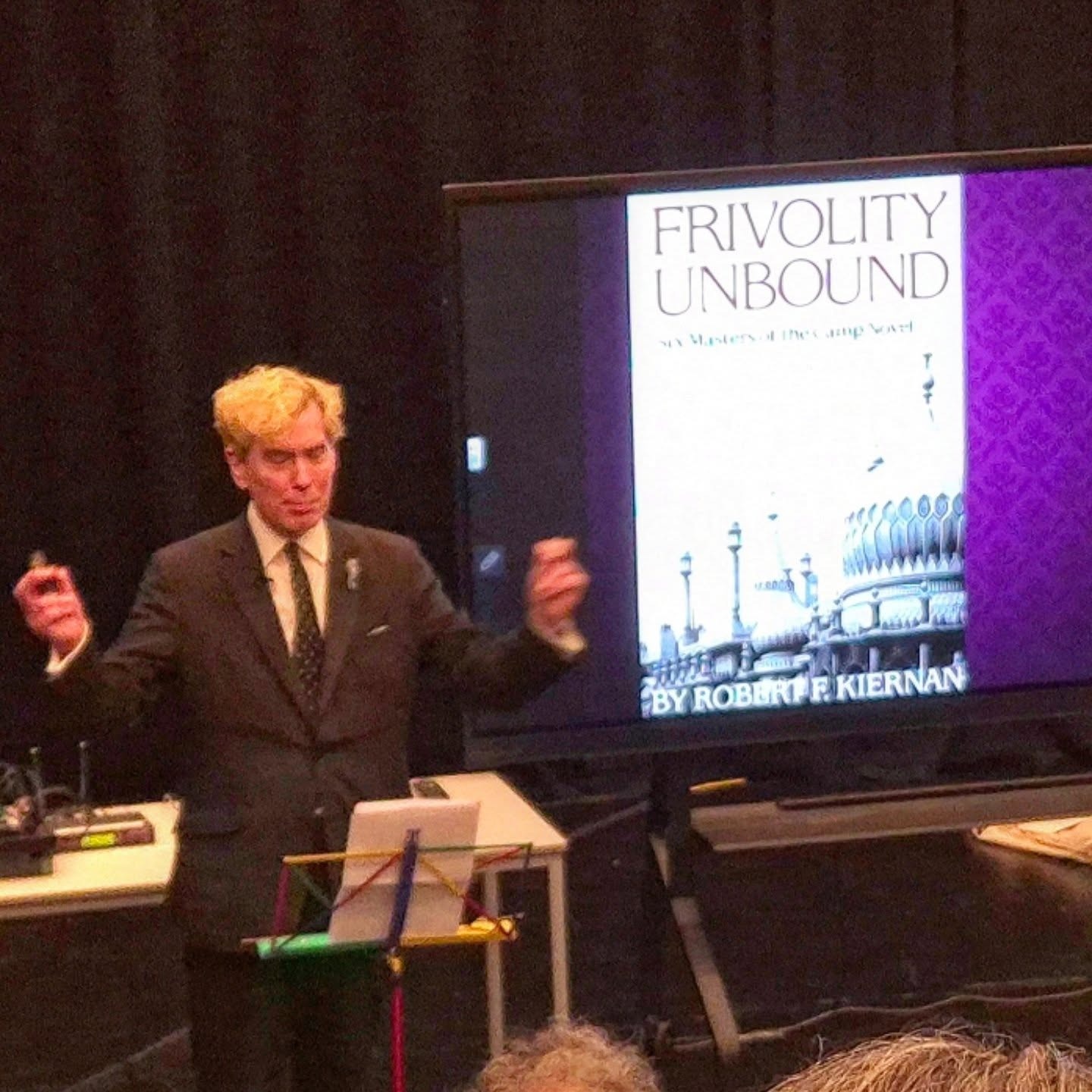
At the Kings Place concert hall I witness old friends being successful. The event is a live version of the podcast Chart Music, in which British music journalists discuss an old episode of Top of the Pops.
Sarah Bee, one of the podcast regulars, has put me on the guest list. I have known her for years. We were both zombies in Shaun of the Dead.
I have never listened to the Chart Music podcast myself. I believe, as Noel Coward did with television, that podcasts are for going on, not for listening to. But this one has been going for ten years, and given that the room is packed with 450 paying fans, is evidently a hit.
The other two speakers are Taylor Parkes, whom I used to see regularly when I lived in Highgate, and the host Al Needham, whom I don’t know but who turns out to be big and loud. He is not, I realise, the music journalist Alex Needham, whom I have met, and who is slim and quiet.
When the presenters walk on, the hall erupts into huge cheers, particularly for Taylor. I have always thought of Taylor as a good conversationalist, with his nihilistic wisecracks and friendly intellect. It also helps that he is good looking, in a tortured poet kind of way.
All three presenters have a sheet of notes to consult, which I soon realise is central to the show’s appeal. These are, after all, professional writers used to giving their words a decent amount of care before releasing them into the wild.
More podcasts should be like this: loose but with a good deal of polish and structure, rather than rambling and directionless. The most popular podcast in the world is The Joe Rogan Show, where each episode goes on for three hours. I could never be Joe Rogan. And this is why I will starve.
This live version of Chart Music is broken up with video clips from the Top of the Pops episode in question: November 1985. Cue lots of mullets and rolled-up sleeves. Mr Needham makes Proustian references to 80s school slang, like ‘skill!’ as a synonym for ‘excellent!’.
Taylor describes the TOTP presenter Steve Wright as ‘dressed like a four-year-old who owns a marina’. He goes on to criticise the title of the A-ha song ‘The Sun Always Shines on TV’: ‘pull the curtains, then.’
Talking Heads, meanwhile, ‘give meaningless pretension a bad name’. Some of the audience are a bit shocked at this.
Taylor goes on: ‘I like the early Talking Heads stuff, but after 1983 I can’t deal with their schtick. It’s like: get a proper suit, you c**t.’
There is a moment where Sarah stumbles over her words and makes a strange yodelling noise, not unlike the catchphrase of one particular TOTP presenter.
Sarah: I think I just went the full Jimmy Savile.
Taylor: Not the full Jimmy Savile.
Afterwards, to the nearby Star of Kings pub. I chat with one of the Chart Music fans, Sam V. She says that it’s like belonging to a ‘family’. Underneath all the jokes about bad haircuts and clothes, the fans have bonded through the need to make sense of cultural memory. Nostalgia can be comforting in a wholesome way, when used socially like this. It can give people a reassuring sense of their own life in history.
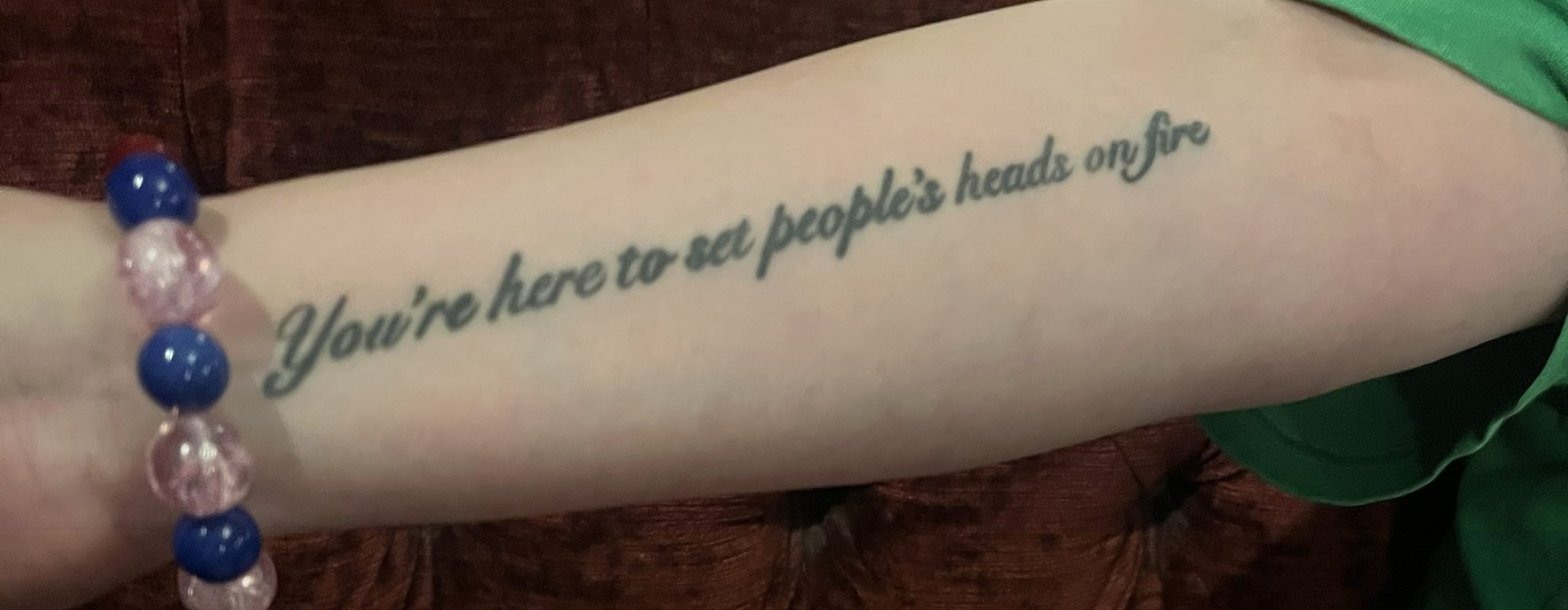
Sam recommends that newcomers to Chart Music should start with ‘any episode with Taylor Parkes and Neil Kulkarni’. Indeed, her love of the podcast extends to a tattoo that emblazons her arm. It is a quotation by Neil K, who died in 2024: ‘You’re here to set people’s heads on fire’.
Sam gets out her phone and shows me the full context of the quote, in an article by Mr K about how to review records. I would say his advice applies to writing about anything:
Accept that everything you say will be forgotten and ignored but write as if you and your words are immortal. Don’t just describe but justify – make sure the reader knows WHY the record exists whether the reasons are righteous or rascally. And always remember you’re not here to give consumer advice or help with people’s filing. You’re here to set people’s heads on fire.
**
Next: I watch a synchronised crowd of Kate Bush impersonators with the man who made the Wuthering Heights video
Notes:
The Douglas Adams quote opens his novel The Long Dark Tea-Time of the Soul.
‘The Neil Kulkarni Guide To Being A Record Reviewer’ was published by the Drowned In Sound website, 13 July 2009.
** This online diary was begun in 1997. It is thought to be the longest running of its kind. The archive contains nearly thirty years of exclusive knowledge, all searchable and free to read without adverts or algorithms or clickbait. It depends entirely on donations by readers to keep it going. Thank you!
Further recollections from the first ‘On Diaries’ event, held at the Betsey Trotwood on 22nd August 2026.
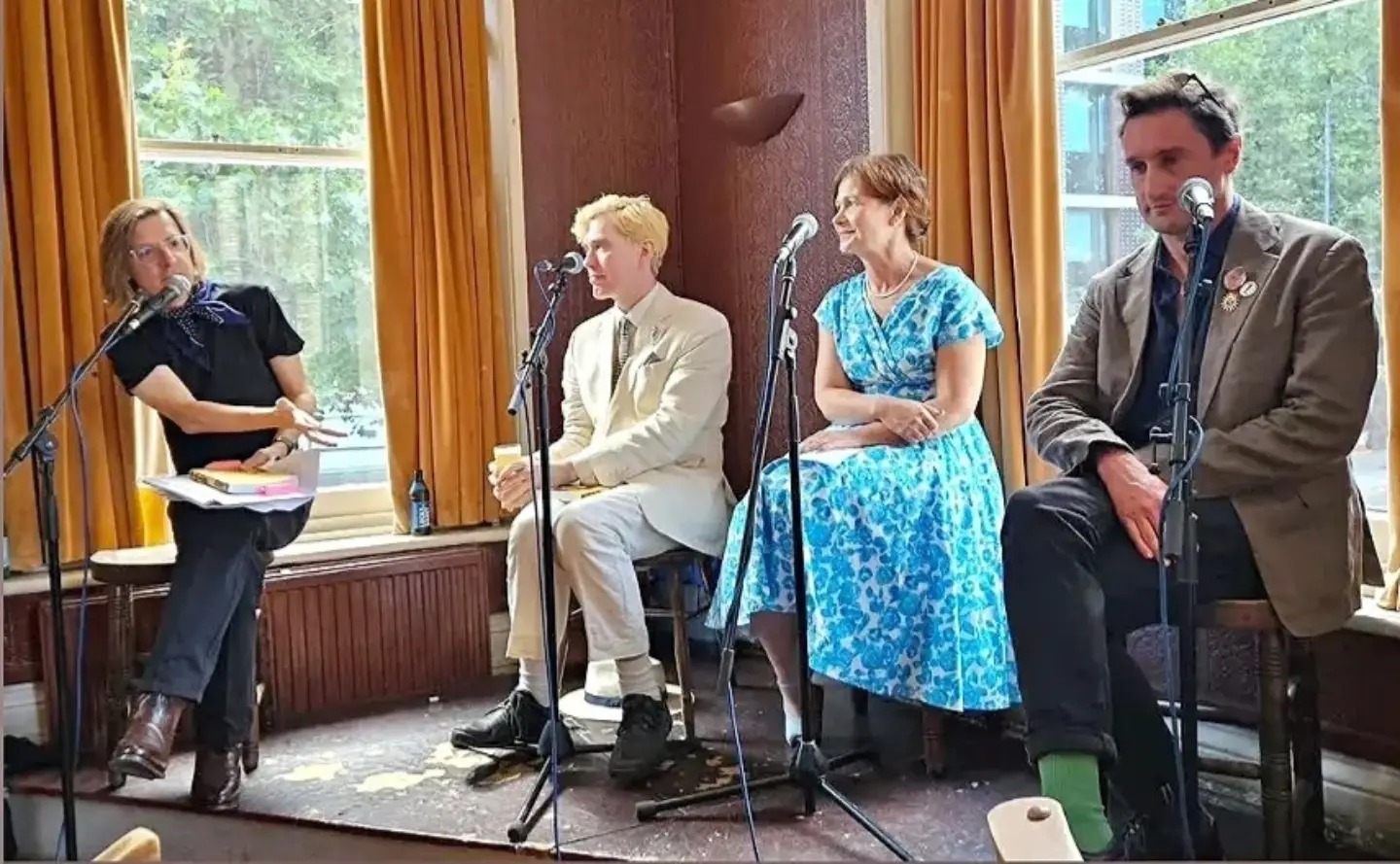
Left to right: Travis Elborough, Dickon Edwards, Victoria Redfern, Robert Wringham
I used to dread public speaking, self-conscious as I was of my strange voice, with its quasi-posh monotone and its lisp. I was sensitive to people mocking me for the way I spoke. But now, as with all people over 50, the mockery is a given: the mockery of the body. So many former anxieties drift away, eclipsed as they are by the gratitude of being alive at all.
I now feel more at home speaking on a stage than I do when not speaking on a stage. I enjoy the process of trying to speak in a polished, quotable manner, as I try to do when writing. It’s a fun thing to live for. And if no one turns up, I can just sit there and work on my phrases. A polished style is its own reward, whether dressing or writing or speaking.
There is a joke among musicians: ‘No tickets sold? Great! Free rehearsal!’
Onstage, I talk about how a good diary shoud record three things: feelings, places, and technology. This leads to Rob W reading an entry by Samuel Pepys, in which Pepys has a boozy night out in seventeenth-century London while becoming addicted to his brand new toy: a pocket watch. Everything is there.
I point out the benefits of reading diary books. Some non-fiction books label themselves as ‘self-help’, or carry the word ‘adventures’ in a subtitle. But all books should be fun and helpful anyway, if they are any good. Any author of anything must leave the reader empowered, or encouraged, or eased, or just entertained.
Diaries are a particularly good way to deal with otherness. This can be the otherness of sickness, or of queerness, or loneliness or simple failure. One example that ticks all those boxes is the diaries of Lou Sullivan, where he deals with being a gay trans man living with AIDS in the late 1980s, as well as being a frustrated author.
The best diaries about sickness include Barbellion’s Journal of a Disappointed Man, Derek Jarman’s Modern Nature, and Virginia Woolf’s A Writer’s Diary, her salve for her mental precarity.
I think of the painter Keith Vaughan, who treated his terminal cancer with an overdose, and wrote his diary up to the very second that he lost consciousness. I once saw his journal on display in a glass case. It was turned to his last words: “It wasn’t such a bad life. I did some good work.” And then the pen drops into a long line down the rest of the page, like a flatlining heartbeat.
In my case in 1997, I was dealing with a rather pettier crisis: the pronounced death of my hopes to be a pop star, with the band Orlando. I didn’t know what to do with myself, so I started a diary.
Writing is a need, but publishing is a risk. Putting one’s life online risks looking deluded or narcissistic, or just adding to the amount of irritation in the world.
Nevertheless, it is the same sentiment as writing graffiti, or taking a photo, or sending a message, or posting on social media. All these activities are saying the same thing: ‘I too am alive.’
Then, when faced with age or imminent death or just the feeling that the world has closed its doors on you, it becomes the need to say: ‘I too was once alive’.
For me, this urge was so strong in 1997 that I couldn’t wait for blogging platforms to be invented. I had to post the first entries in raw HTML code. It felt like the Puritans at Plymouth Rock. That thrilling new world, that fresh blank space of sanctuary, the 1990s web.
Back then, normal people scoffed at the internet. They called it a kind of CB radio for lonely misfits who couldn’t get a proper publisher or a record deal. That was of course what we liked about it. Good, we misfits thought. Leave us our sanctuary.
Then in the 2000s, normal people joined the internet. And ruined it. I am now a lone, peculiar, crumbling old chapel in a city of identical skyscrapers. But I too am alive.
The problem with social media is not only being at the mercy of dubious private companies, who can delete your post or even your whole account without warning. The true problem is that many people waste their chance to say something different. They have the power to get a message out to the whole world at once, something that was dreamed of by their ancestors.
And yet nearly always this message is the same: ‘Here is my cat. Here is my breakfast. Here is my bottom’. The breakfast one is the least excusable.
So in a time of widespread narcissism it is important to practice wholesome narcissism. Putting this desperation to be liked to good use. Hence my mission to get people to think about diaries. Writing a diary, whether online or on paper, offers far more control and is much better for the mind.
Memoirs are hampered by structure, but anything goes with a diary book. Much of Volume One is meant to entertain, but there is some sadness there too. In the final entry there is a scene in a late night takeaway where I am first mocked then physically assaulted. You will have to buy the book to learn what I did in response, but suffice it to say that unlike Phil Spector I did not pull out a gun.
At the Betsey Trotwood, Rob Wringham, who is not just one of the performers but is also the book’s publisher & editor, is asked why he chose to end with that entry:
‘I wanted people to know what it costs to be Dickon Edwards.’
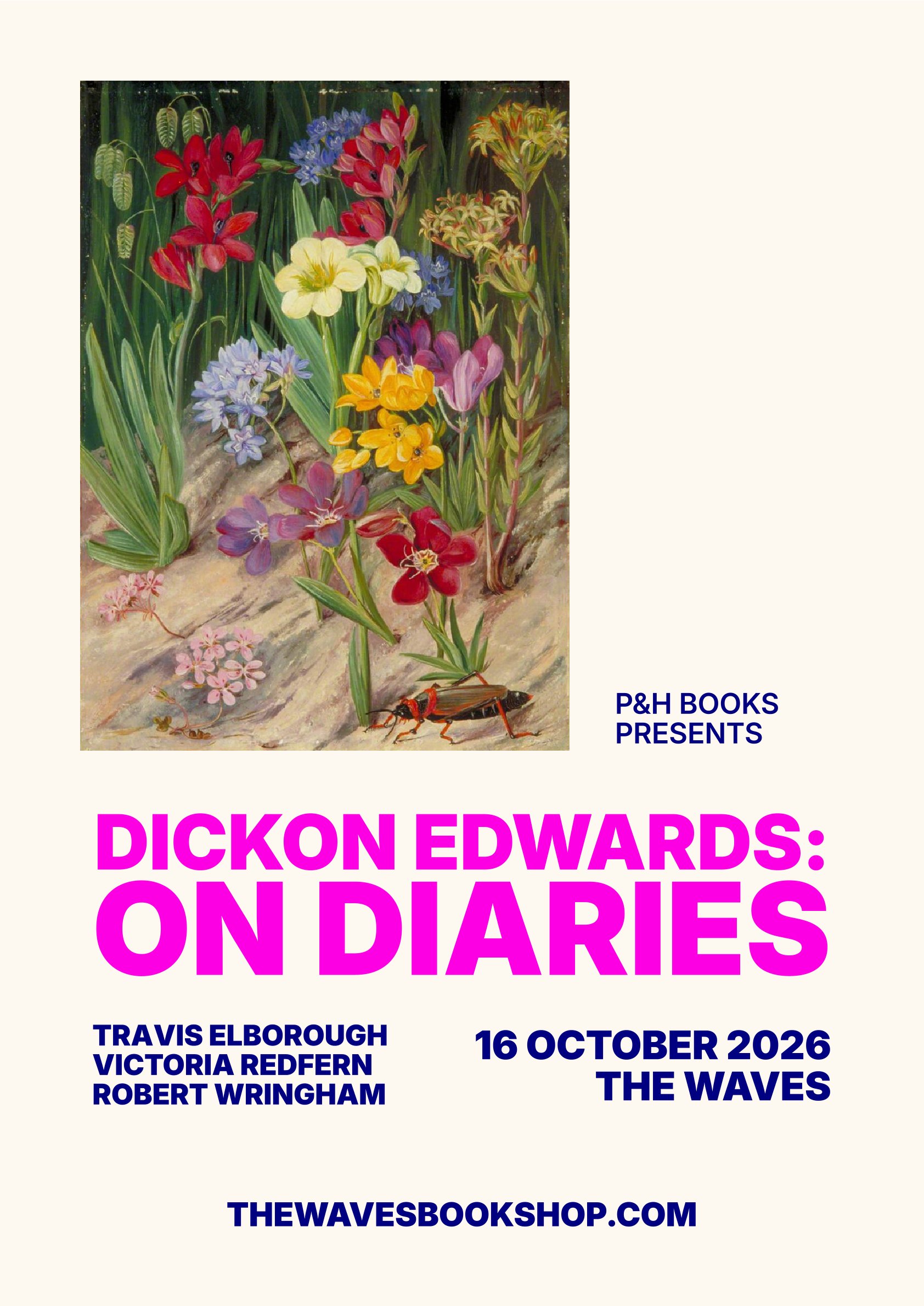
The next show is in Hastings, at the Waves Bookshop, on Friday 16th October, 6.30pm. Free but places must be reserved on Eventbrite (link).
Next: I return to London to discover that old writer friends have become podcast superstars.
**
A paid subscription to my Substack, Svelte Lectures (link), grants you access to many exclusive articles, all of whichare intended to leave you feeling better off. There are pieces on Shakespeare and flowers, Heartstopper and the Carry On films, Christopher Nolan’s homoerotica, Angela Carter meets the Beatles, and the dandyism of Muriel Spark.
** This online diary was begun in 1997. It is thought to be the longest running of its kind. The archive contains nearly thirty years of exclusive knowledge, all searchable and free to read without adverts or algorithms or clickbait. It depends entirely on donations by readers to keep it going. Thank you!
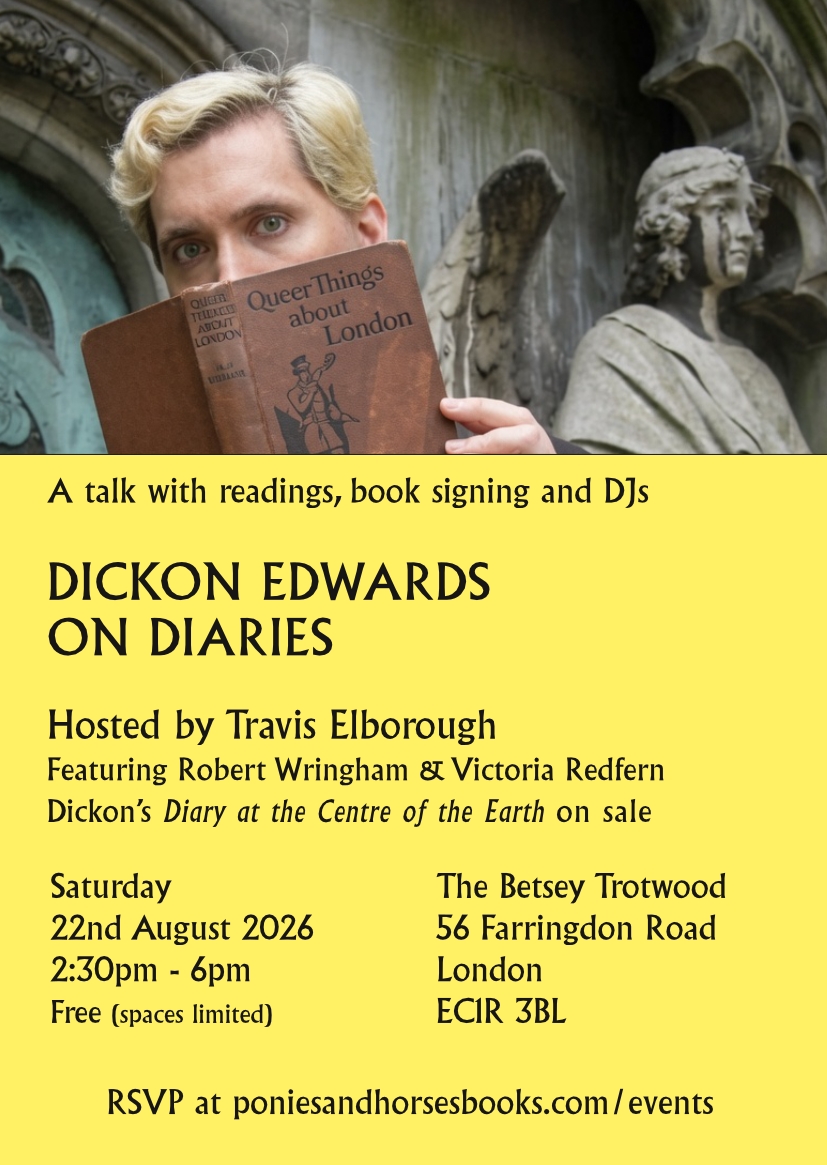
Saturday 22nd August 2026. To the Betsey Trotwood in Farringdon, London, for the first outing of the Dickon Edwards Diary Show.
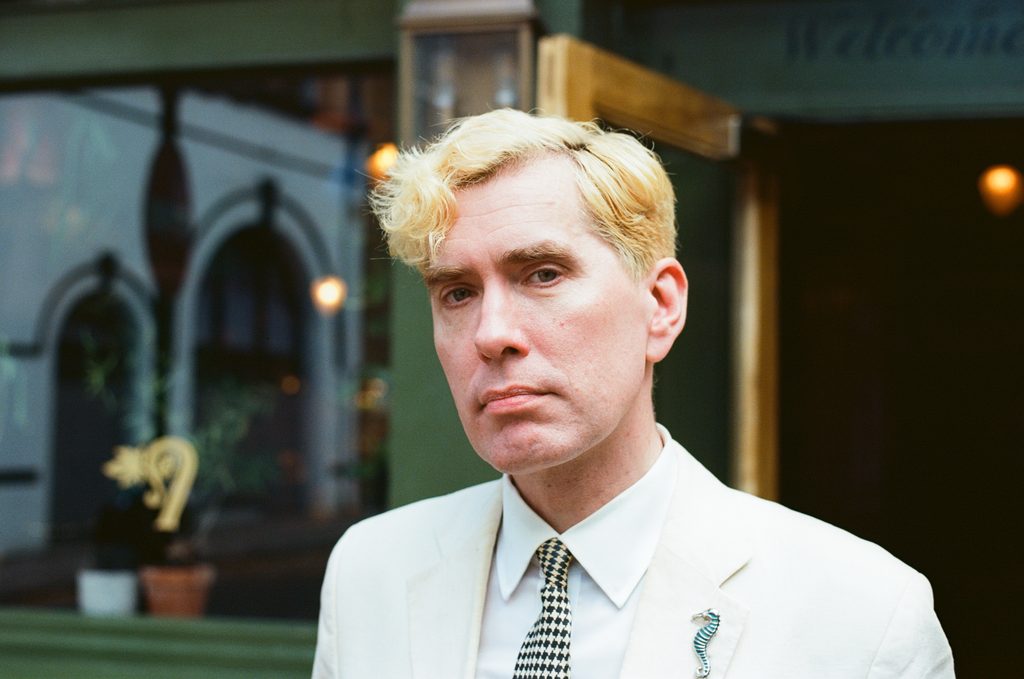
Dickon Edwards, London, 22 Aug 2026. Photo by Travis Elborough.
Rather than have a straightforward launch-style event at which to sell the slightly improved second edition of my book (Diary at the Centre of the Earth Vol 1, 1997-2007), I devised a salon about diaries as a whole, with my book as one of several examples. For this first outing in London, I added my own selections from the diaries of Virginia Woolf, Samuel Pepys, Derek Jarman, and Helen Garner.
Svelte Lectures is a reader-supported publication. To receive new posts and support my work, consider becoming a free or paid subscriber.
As well as myself onstage, there was a host to ask me questions (Travis Elborough), two actor friends reading (Victoria Redfern as Woolf and Garner, Rob Wringham as Pepys and Jarman), plus three DJ friends to provide a suitable ambience before and after the performance (Shanthi Sivanesan, Ian Watson, Alex Mayor).
Alex M later said that this format was ‘Like BBC Four, but in a room’.
I was going to call the event ‘Club Dickon’, but Victoria R said that sounded like an invitation to have me bludgeoned.
As it turned out, the event was something between Dickon Edwards, This is Your Life and an early birthday party, given I was about to turn 55. I rarely have actual birthday parties, and will tell you about what I did do on my birthday on the 3rd September in a subsequent instalment.
But at the Betsey event I was delighted to reunite with unexpected people from across different chapters of my history, all of whom I hadn’t seen for some time. These included Rachel Stevenson, of my band Fosca, whom I first met at indiepop gigs in the early 1990s, and Professor Joseph Brooker, of Birkbeck University, who co-supervised my PhD thesis from 2017 to 2022.
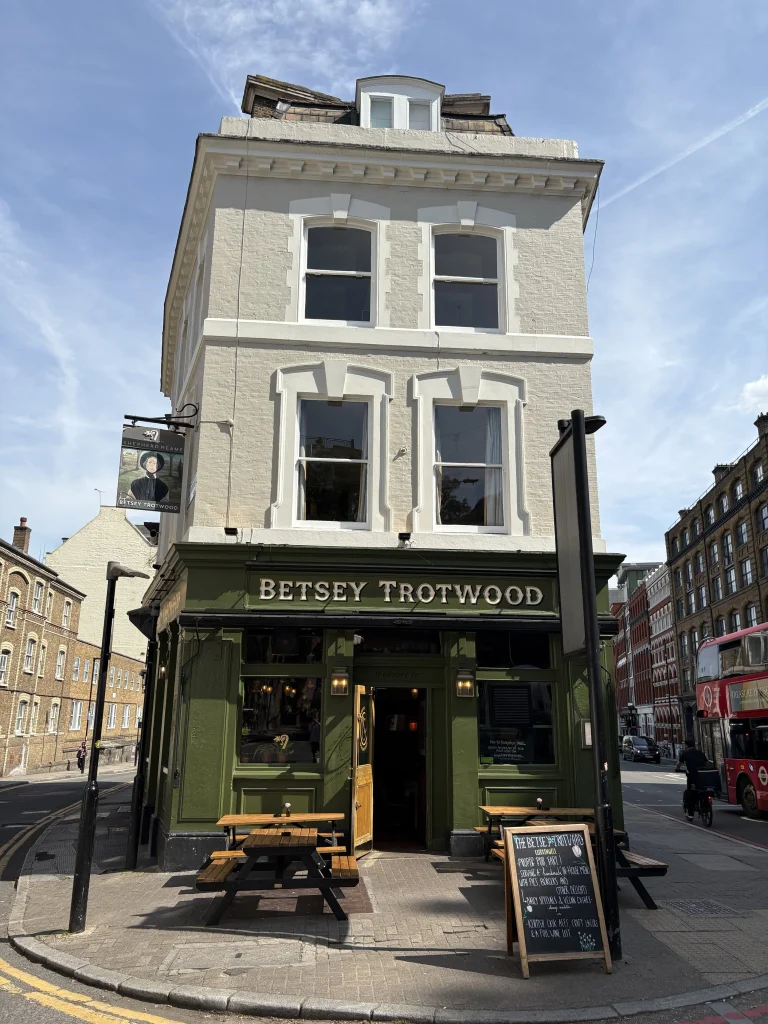
Travis E secured the venue for us. The Betsey Trotwood was perfect: the site of indiepop club nights in the past like Track & Field. But architectually appropriate too: a colourful and ornate survivor of London past, a sign of independent humanity on a traffic island amid the harsh corporate buildings that speckle the Farringdon Road, not least the UK headquarters of Linkedin.
This area of London is Dickens country, with Saffron Hill from Oliver Twist around the corner, and Betsey Trotwood herself a Dickens character. How apt, then, to have the LinkedIn building glowering at the Betsey from across the road; LinkedIn, that unlovely employment website where human beings are forced to jump through digital hoops against their will in order to prevent poverty. The current incarnation, in fact, of the Dickens workhouse.
I do not know the Betsey’s manager, Patrick, but in an email to Travis he said he ‘knew Dickon’s late brother Tom very well’, and so was happy to let us use the venue.
I am rather touched by this, and so is my mother when I tell her on the phone. I talk to Mum about my improving confidence in public speaking. She adds that when were were both small children, it was me who was more keen on performing than Tom. In the primary school nativity play, I demanded to be made Head Angel. I can still remember the dance moves. And I remember that I was the only boy angel, too; all the others were girls.
Tom, on the other hand, was so reluctant to go on stage that the school had to find him the least prominent role possible. Mum says, ‘In the end they made him a non-speaking camel.’
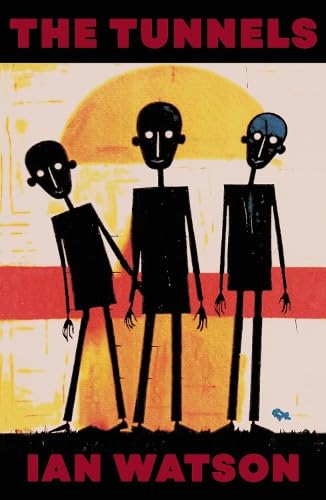
At the Betsey, Ian Watson thanks me for a particular diary quote I had passed on. He says he found it useful when he was struggling to write his comic novel, The Tunnels, which has just come out.
The quote is from the diary of Christopher Isherwood, and is a good tip for writer’s block:
Every day I get some more of the book done. It’s hopeless, almost incoherent, but that doesn’t matter; one NEVER regrets writing anything. The jungle is being cleared. – Christopher Isherwood, diary, 6 Jan 1974.
I recommend Ian’s book The Tunnels, by the way: by far my favourite novel to feature Boney M references and grumpy minotaurs.
As the event begins, Shanthi plays ‘He’s a Rebel’, the 1960s hit by The Crystals, produced by Phil Spector. It is her affectionate reference to me. I have not really thought of myself as a rebel. But I suppose I must be by default, in a weird and soft sort of way. I recall how the main biography about Phil Spector is also titled He’s a Rebel, and how Spector spoke with a lisp, like me. When people mocked the way Spector spoke, he would pull a gun on them. This same reflex eventually led to him being jailed for murder. That’s where I hope, at least, that my rebel aspect diverges.
I wonder if I can count as a cosy rebel? The biggest book trend right now is for ‘cosy crime’. Murder mysteries in comforting English settings, usually by an author called Richard. There is Richard Osman from the cosy BBC show Pointless, andRichard Coles, the Communards musician turned cosy BBC vicar. The trend may partially be the fault of Richard Curtis, of Love Actually and Four Weddings, whose name has been associated with fictional English cosiness for some time.
I too am a Richard (my official name), so by rights I should try writing a cosy English novel. I certainly enjoy afternoon tea and avoiding swearwords.
At the Betsey I tell Ian Watson, who is a veteran music journalist, that perhaps I could draw on my background of 1990s indiepop for a cosy crime story. Murder in the Kentish Town Bull and Gate! At midnight, found dead in a pool of cider and black: the editor of a weekly music paper!
Ian says there’d be too many suspects.
To be continued…
Appeal: My total earnings for last month were under £100. Hastings Job Centre say they do not have anything for someone with my ‘high end qualifications’, as they put it. So please do take out a paid Substack subscription or donate to the diary site if you can. A paid subscription gives you access to all the carefully polished Svelte Lecture posts from the past, but more importantly it is a direct means of proving that you think my work is enjoyable, and that it should continue. And indeed, that I should continue. Thank you!
** This online diary was begun in 1997. It is thought to be the longest running of its kind. The archive contains nearly thirty years of exclusive knowledge, all searchable and free to read without adverts or algorithms or clickbait. It depends entirely on donations by readers to keep it going. Thank you!
I am told that there are still tickets available for my special ‘On Diaries’ event on the afternoon of Saturday 22nd August, at the London Betsey Trotwood. The tickets are free, but they must be reserved in advance from poniesandhorsesbooks.com/events. There are currently twenty-five tickets left.
At the event I will sign books and answer questions, via my preferred Q&A system involving mini golf pencils and postcards. I will pass on what I hope are entertaining insights about diaries and the human condition, fiction versus non-fiction, and the problems of telling the truth. There will be guest readings from the diaries of Samuel Pepys, Virginia Woolf, Helen Garner, Derek Jarman and Alan Bennett, as well as from my own diary. I will also talk about how writing and reading diaries is good for one’s creativity, and good for one’s health.
I have told all the usual outlets but am a little worried that the event might be under-attended. Facebook and Instagram are now so cluttered with adverts and sponsored posts that it’s perfectly possible to miss out on something that you might have wanted to go to, if only you had known.
What does makes people go to events?
Yesterday evening in the UK, many people gathered to watch the solar eclipse. Here in Hastings the beach was packed. I went down to have a look. Crowds upon crowds were there, the most I have seen on the beach since I moved here, all bathed in the strange semi-dappled light. Many were fiddling with pinhole cameras made from cereal boxes, some were using special eclipse glasses that look like 3D glasses, others were gazing intensely at their kitchen colanders. It was an atmosphere of surrealism, uniqueness, and rarity.
On the 22nd I like to think I too can promise surrealism, uniqueness, and rarity. Rarity, because for some reason I’m not getting many bookings at the moment. I like to think this is down to what Hastings Job Centre told me about having a PhD in English and Humanities:
‘I’m afraid we don’t have much for someone with your… high end qualifications.’
(Later, in bed…)
I can certainly promise surrealism at my event, because it’s me. Yesterday, on the 323 bus, dressed in my heatwave look of a broad-brimmed hat, sunglasses and white suit, I was told by a small boy: ‘You look like Michael Jackson’.
Today, the real Michael Jackson is 0% present. The solar eclipse, for all its popularity, was only 90% present.
At my event, however, I will be 100% present. And I too am known for being something unusual to stare at, with or without a colander.
Perhaps I should also compare my event with one of the most discussed cultural events at the present moment: the film The Odyssey, directed by Christopher Nolan.
This film was shot entirely on 70mm IMAX, a format which in the UK can only be properly viewed, in terms of the director’s intended resolution and screen size, in three cinemas (London BFI, London Science Museum, and Manchester Printworks). Tickets for screenings of The Odyssey at those cinemas have long sold out, as one might imagine.
My event at the Betsey Trotwood is not yet sold out. But it will, I can promise, feature my preferred resolution and size for the content. As in: me. In person. It will be like I am in the actual room with you. Because I will be.
I wonder now if having a free event risks having more people not turning up than if it was, say, £1 to get in. Some people are very strange about price and value, as Oscar Wilde did not quite say.
A case study suggests itself. Recently, one of my attempts to postpone starvation was to be paid for digitising an LGBTQ+ newspaper archive. This included the column, ‘Gay Girl About Town’, by Jane Czyzselska, which appeared in the free daily London newspaper The London Paper in the late 2000s.
Having to leaf through old copies of this newspaper immediately brought back memories of that most baffling of historical eras, the recent past. The London Paper ran from 2006 to 2009, and had a rival, London Lite, which ran for about the same time. Both these newspapers became notorious in London, not for anything their writers said but for a psychological side-effect of what happens when people are given something to read for free. Litter.
And litter in huge amounts too. My abiding memory of London during the late 2000s is of buses and tube trains covered in discarded newspapers by the end of the day. It was a time of giant travelling hamster cages.
There were adverts everywhere to remind people to dispose of their free newspapers properly. There were even designated recycling bins for this very purpose, paid for by the free newspaper companies (after they were forced to do so). But the problem persisted.
Newspapers that cost money, meanwhile, like the Times and Telegraph and Daily Mail, were far less likely to be dumped in this way. The theory was that the consumer had made a personal investment, and so treated their possession with more respect.
I remember once in the late 2000s I got so upset about the free newspapers ruining a London night out that I once walked the entire length of a tube train, going through every carriage, and picking up every discarded London Paper and London Lite that I saw. It was a good fat armful – I could barely carry them all. Then I took them off the train at Highgate, where I lived, and dropped them into the recycling bin at the station entrance. I was probably drunk, but that’s not the point.
All of which is an attempt to say: please do come to my event on the 22nd. It is free, I am afraid, but I hope that does not put you off. Besides, as with most book events there will be nice things on sale to buy (my book). After all, there is no sight more comforting to the lover of culture than a merchandise stall. Perhaps I should do Dickon Edwards colanders.
**
Also in London that weekend is a rare screening of Melt It! The Film of The Iceman, which I recommend. A fascinating account of the time when alternative British comedy could mean performance art, rather than stand-up. Sunday 23rd August, 7.30pm, The Bill Murray, N1 8NQ.
** This online diary was begun in 1997. It is thought to be the longest running of its kind. The archive contains nearly thirty years of exclusive knowledge, all searchable and free to read without adverts or algorithms or clickbait. It depends entirely on donations by readers to keep it going. Thank you!
Wednesday 29th July 2026. I have to get a spot on my leg looked at, and am sent to see an NHS specialist in a room at the Hillbrow Swimming Pool and Health Centre, deep in the suburbs of Eastbourne. The bus from Eastbourne railway station to Hillbrow zig-zags through interminable rows of houses. I feel very much closer to death by the time I get off. On the way back, I make the most of the trip by stopping off at the Towner Gallery & Cinema, with its permanent display of Eric Ravilious and Tirzah Garwood.
My friend Oskar thinks that the reason I have to go to this suburban swimming pool in a different town, rather than to some hospital in Hastings, is because the NHS is especially struggling on the coast, what with all the old people. The joke about Eastbourne is that even the shop windows are bifocal.
In fact, I now live next door to a care home. The other day they had a be-quiffed Elvis Presley impersonator performing to the residents in the garden, using a backing track. He left to the announcement on the PA that ‘Elvis has left the building’. I worried that this phrase might be construed as poor taste, given that it’s also slang for death. But no, here it was meant perfectly literally and cheerily.
I wonder if my generation will be similarly entertained in our care homes by, say, Liam Gallagher impersonators. As if elder abuse wasn’t bad enough.
Back at the health centre in the middle of nowhere, I ask the specialist if I can put my foot on her desk to steady my leg while she photographs the spot with her two-handed medical camera. ‘No,’ she says, very sharply and very, very quickly.
It’s like the time when I went to see a GP and she lectured me about my lack of exercise. She said: ‘Sitting is the new smoking’. I wanted to say: ‘No, it isn’t.’
I like the idea of saying ‘no it isn’t’ to doctors, in the style of a pantomime. Just as I like doctors saying a quick stern ‘no’ to me when I ask to put my awful foot upon their lovely desk.
*
Sunday 2nd August 2026. I am listening to the album Our Tanks – Your Lawn!! by The False Dawns, which came out last year. I am mentioned twice in the CD artwork.
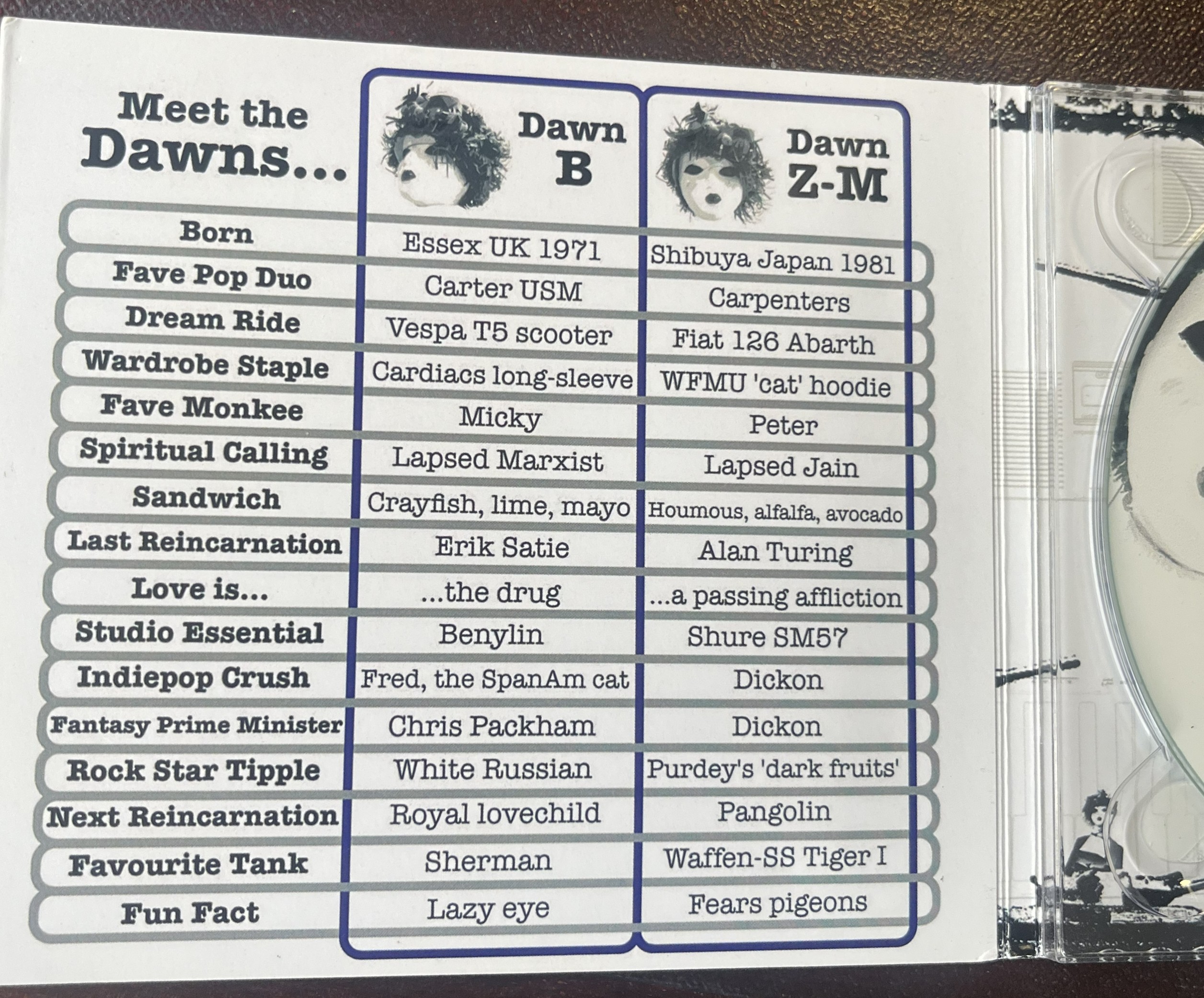
The False Dawns is a solo project by the singer-songwriter Huw Darling, of the Letchworth band The Spanish Amanda. His music is witty, bookish indiepop in the mould of acts like Momus and the King of Luxembourg.
On the album artwork, Huw is pretending to be a fictional indiepop girl duo, both of whom are called Dawn. On the sleeve, one of the Dawns describes herself as born in Japan in 1981. She names me as both her ‘Indiepop Crush’, and her ‘Fantasy Prime Minister’. The other Dawn’s choices are, respectively, Fred the Spanish Amanda Cat, and Chris Packham, the TV nature presenter, who in all seriousness probably would be many people’s choice of prime minister.
Huw sent me the CD, and enclosed a postcard describing the mention of my name on the sleeve as ‘first class toadying’ on his part. If he expects me to spread the word about the album, which is available to buy at thefalsedawns.bandcamp.com, he has another thing coming.
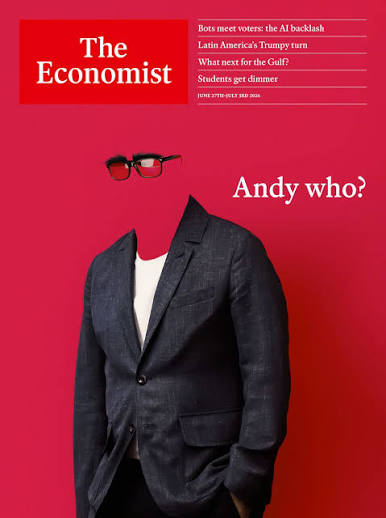
But perhaps the thought of me as Prime Minister is not such a fantasy. Britain has just acquired a new PM for the seventh time in a decade. This time it is Andy Burnham. My own brief stint at the slippery steering wheel can therefore only be a matter of time. In the future, everyone will be Prime Minister for fifteen minutes.
The media has desperately tried to play up the new PM’s looks into a cartoonish trademark, even though he is relatively ordinary-looking. Or at least is now. Years ago, when he first ran for the Labour leadership against Ed Miliband, cartoonists made fun of his long, wonderfully feminine eyelashes. He has since covered those up with a pair of glasses. A shame.
The cliché is that one can experiment with make-up and gender ambiguity in youth, but by middle age one has to settle down, pick a side, grow a beard, pretend to understand football, wear glasses. The current term in queer parlance is ‘twink death’, with ‘twink’ being a young, beardless, boyish man.
Despite the popularity of beards with declining twinks elsewhere, beards do still seem to have a electability problem for male politicians. The last bearded prime minister was Lord Salisbury in 1902. It is perhaps too much of a stretch to say that Jeremy Corbyn’s failure to become Prime Minister was entirely due to his beard. But the facts are there. In late 2019, the public finally had a beard on their hands. Instead they plumped, of course, for a Wodehousian overgrown boy, a clean-shaven cartoon.
Hence for their recent front cover, The Economist fought against Mr Burnham’s twink death by turning him into just a pair of thick eyebrows over a pair of spectacles.
When I bumped into an old friend after many years apart, he accused me of ‘going casual on us’. He meant that I was no longer wearing make-up, as I had done for much of the 90s and 2000s. I was now opting for glasses (or sunglasses) over contact lenses. I was hurt by this, but have since made up for it, I hope, with the hair and the suits.
In a culture of too much information, strong looks can cut through chaos. They can be a comforting landmark for the public, a fixed point, a calming handrail.
You know where you are with a strong look. You know who you are. When people shout at me in the street, or have an opinion on a new prime minister or the new film of The Odyssey, they are really defining themselves. All reviews review the reviewer.
Next gig: London, Betsey Trotwood, 22nd August, 2.30pm. The book Diary at the Centre of the Earth Vol 1 is available from The Waves Bookshop, Hastings, or from poniesandhorsesbooks.com.
** This online diary was begun in 1997. It is thought to be the longest running of its kind. The archive contains nearly thirty years of exclusive knowledge, all searchable and free to read without adverts or algorithms or clickbait. It depends entirely on donations by readers to keep it going. Thank you!
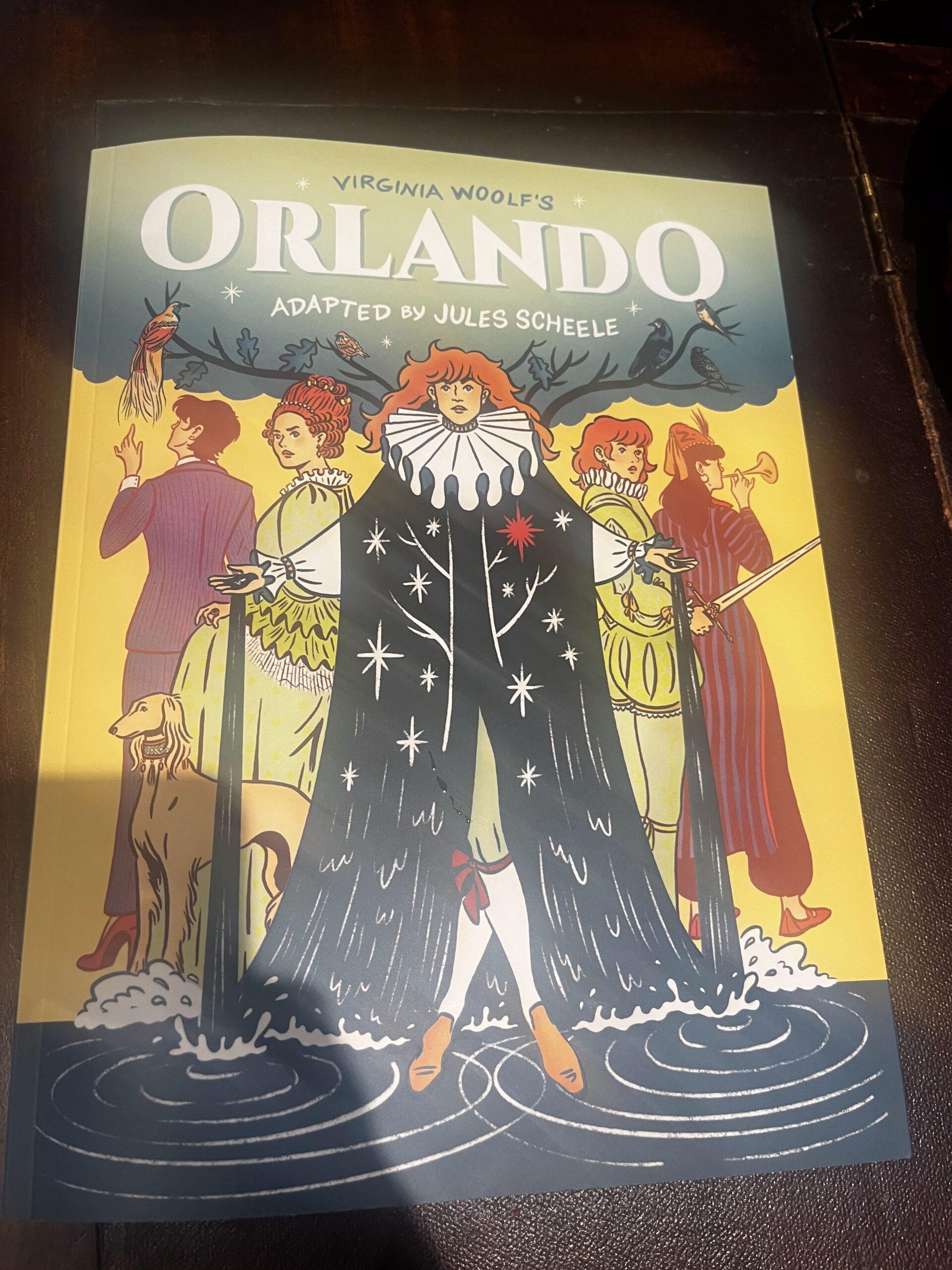
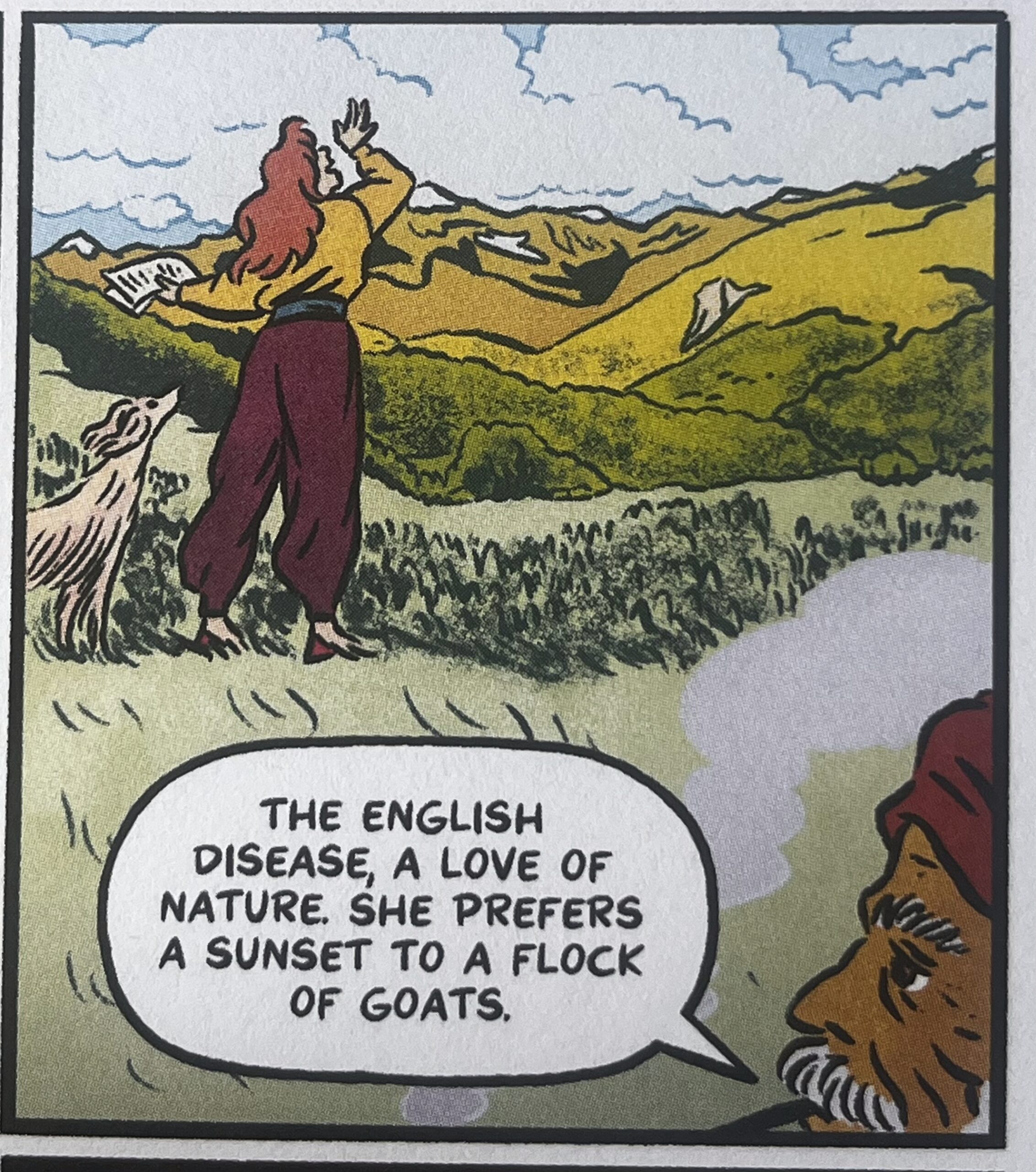
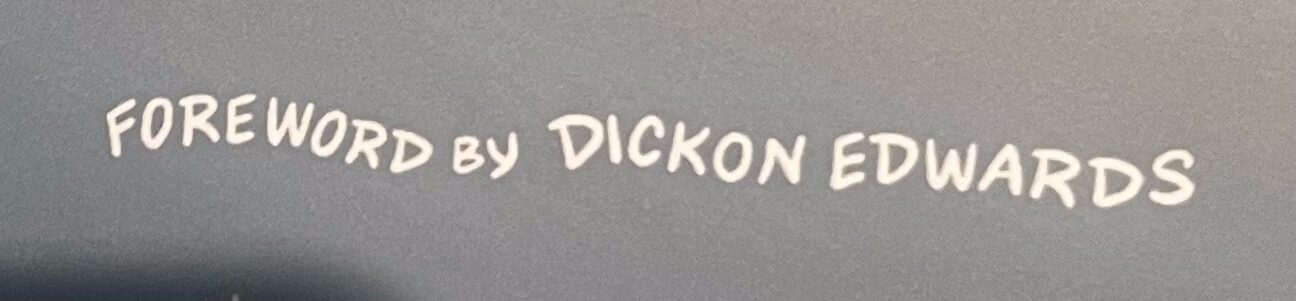
Some book news. I have written the foreword for the new graphic novel version of Orlando by Virginia Woolf, adapted by Jules Scheele. The book is colourful and sexy and is out now, published by Avery Hill of London, UK.
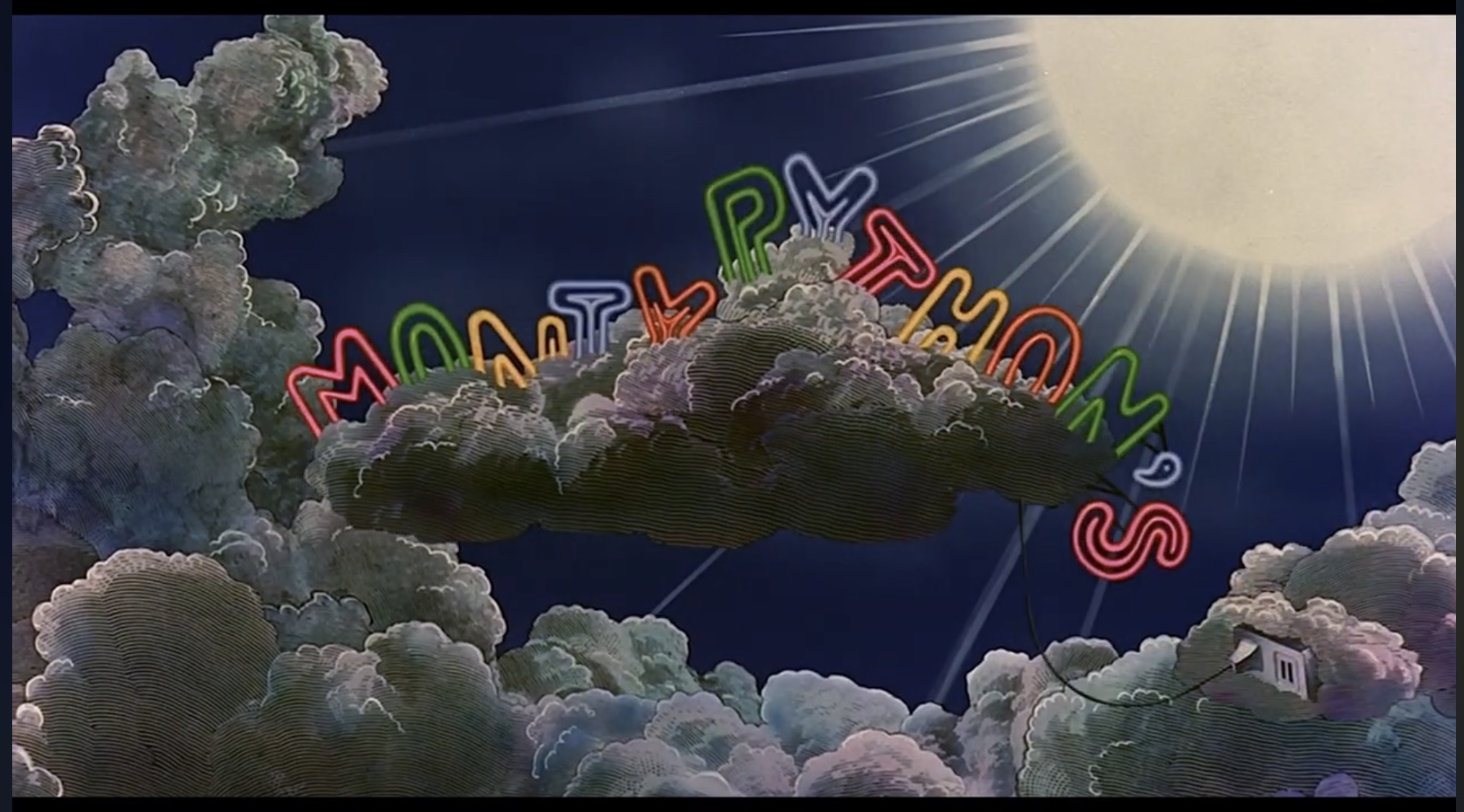
I like the way Mr Scheele has rendered my name on the back cover, in wavy letters to match his and Woolf’s names on the cover.
I think of the opening titles of Life of Brian, where the words ‘Monty Python’s’ are a wavy neon sign on a cloud.
Opening titles of the 1979 film Life of Brian.
Some show news. I am appearing at a Saturday afternoon event about diaries in London.
I will be discussing how to write a diary, how to read a diary, and why diaries are good for you. Travis Elborough will be interviewing me, and I will sign books. There will also be DJs and guest readers, who will read diary entries by the likes of Samuel Pepys, Derek Jarman, and Virginia Woolf. The venue is the Betsey Trotwood, 56 Farringdon Road, London EC1R 3BL, Saturday 22nd August, 2.30pm-6pm. Free entry, but tickets must be reserved on Eventbrite. https://www.eventbrite.co.uk/e/dickon-edwards-on-diaries-tickets-1992055199727
**
New Diary Entry:
Sunday 21st June 2026. To Hastings Museum for the Sanctuary Festival, a free event to raise awareness of refugees. It is a hot, sunny day and the museum grounds are packed with stalls, stages and people, spilling out onto the grounds of the Summerfields Leisure Centre next door. As I pass I see a small stage at one end, with a choir singing Joni Mitchell’s ‘Big Yellow Taxi’ in multi-part harmonies.
When I first moved to Hastings after so long in London, I was warned: ‘you’ll get bored!’ But there really does seem to be a different festival in Hastings every week. And the festivals are usually so popular that, as Wilde pointed out about galleries, even if the entertainment is not interesting, one can enjoy looking at the other people there.
I used to feel awkward attending festivals at which I had not been invited to appear, as I became too envious of those who had. Particularly if I thought that some of those who had been invited to appear were manifestly less interesting than me.
I have since resolved this dilemma by (a) getting paid to do a PhD, which rewired my brain into a more graceful machine; (b) having a book out; people always need to have something to buy, to reify their interest, to shore up their encounter with your art; and (c) regarding myself as a one-man festival wherever I go.
This is a dandy version of positive thinking, though the principles can be used by anyone. Cultivate an appearance that is very ‘you’, celebrate all the things that you like, and direct others to these things as well. Be your own festival, at all times. Bring the festival.
Indeed, one can use an internet diary as a form of festival. An online space is known as a ‘platform’, after all. All the internet’s a stage.
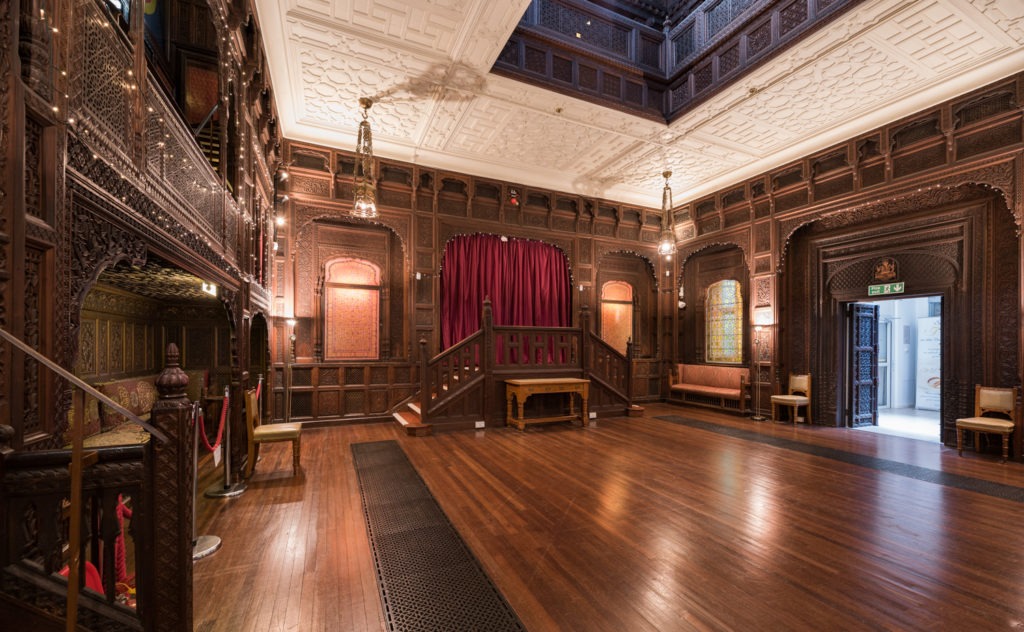
In this spirit, at the Sanctuary Festival I enjoy Remi Graves’s poetry salon, organised in collaboration with the Hastings Queer History Collective. Superb readings by Graves along with Abu Leila and Basil Alsheikh, on queerness, race, migration, and growing up in warzones. The setting is the museum’s Durbar Hall, a spectacularly ornate room made from dark wood carved in an Indian palace style. It was originally made in 1886 by two Punjabi craftsmen, Mohammed Baksh and Mohammed Juma, for the Colonial and Indian Exhibition in London. Having this product of the British Empire serve as a backdrop to poems on 21st century migration gives this event something of a site-specific frisson.
The Durbar Hall, Hastings Museum. Photo by John Fox. From the museum website.
Abu Leila reads from a smartphone, a typical practice at poetry readings now. In between each poem they pause for some time. I think at first that this is an artistic touch, to allow the poem to properly take its hold on the audience. But I then realise that they are just scrolling to find the next poem, in the same way that one might flick through a notebook. For all my love of analogue media, I have to praise phones for the way they can hide the nuts and bolts of life. Phones may turn some people into mindless zombies, but they can also turn them into mindful monks.
I am particularly taken by one of Graves’s poems, ‘Held’, which makes me think of ‘We Two Boys Together Clinging’, the Walt Whitman poem that inspired the David Hockney painting of the same name. After the poetry event I walk into the room next door to look at the museum’s temporary exhibition on local queer history, Lemons, Laws and Secret Doors. ‘Lemons’ being local slang for lesbians in the twentieth century. One of the displays features that same Hockney painting, used here in the story of a local gay couple, Charles and Jeremy. They met in the early 1980s and are still together today. In 1981, Charles sent Jeremy a postcard of the painting as a Valentine’s Day card. Years later they had the ‘We Two Boys’ phrase made into a neon sign for their kitchen in Hastings. The sign is in the exhibition. It further turns out that Hockney lived in Hastings himself in 1958, specifically at Cliff Cottage, West Hill, St Leonards.
The Lemons exhibition is full of rich detail illustrated by ingenious ideas. A canvas installation is painted to resemble the outside of a rocky cliff. This is to commemorate the gay discos held in the 1980s in St Clements Caves, a venue carved into the solid rock under the West Hill. Visitors to the exhibition are invited to put their heads through a flap in the canvas, where they see a video of 80s people dancing to Bronski Beat’s ‘Smalltown Boy’ and Hazell Dean’s ‘Searchin’’. I nearly titled this diary entry ‘The Caves of Hazell Dean’.
Another exhibit is a 1980s-style community notice board, made up of typewritten advertisements on pinned postcards. The twist is that the adverts are for local queer organisations operating in 2026, like the publisher Cipher Press, the club night Laundry Day, and the ‘wrestling cabaret’ Hagstone Stunners. To see an Instagram ‘@’ address typed onto a postcard by a 1980s manual typewriter gives me a feeling of uncanny giddiness. It surely risks summoning some kind of time demon, like an episode of Sapphire and Steel.
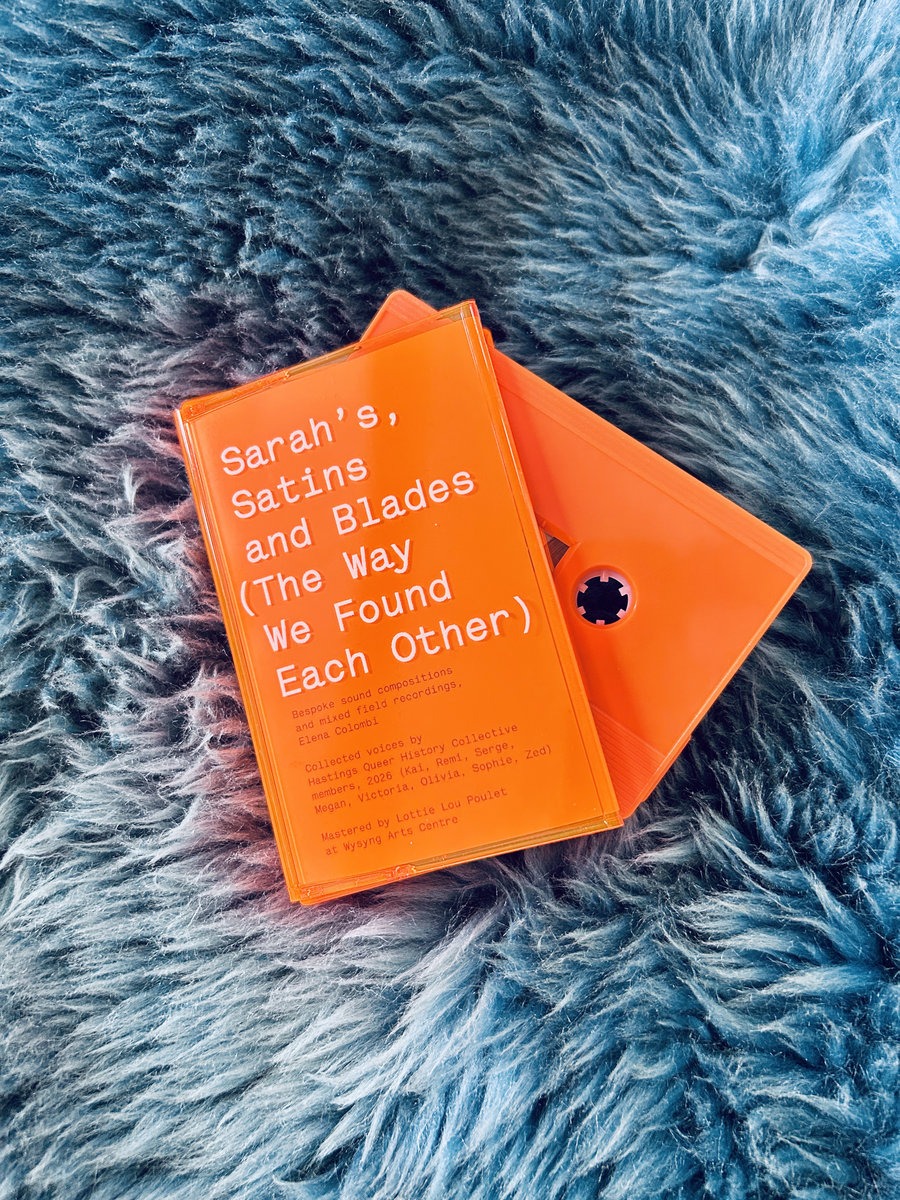
There are further games with anachronisms. The visitor can listen to a cassette recording of readings from newsletters produced by Hastings gay societies of the 1970s and 80s, blended with new music by the DJ Elena Columbi. The cassette and its cover are rendered in a very contemporary design in clear orange plastic, so the object manages to look new and old at the same time. I buy a copy in the museum shop. It must be the first cassette I have bought in thirty years.
Cassette byElena Colombi with the Hastings Queer History Collective: ‘Sarah’s, Satins and Blades (The Way We Found Each Other)’. Available from Osàre! Editions on Bandcamp.
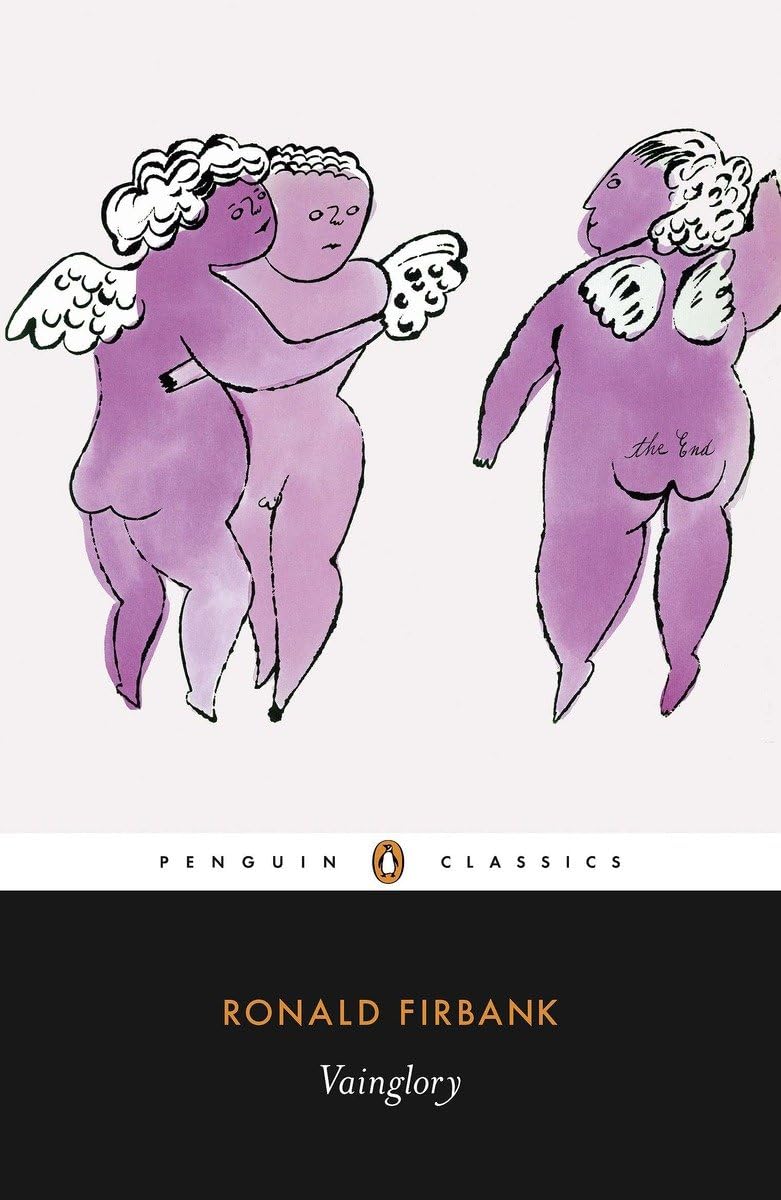
Mr Firbank’s Vainglory is the most perfect flower of a fatigued society which, having produced this masterpiece, can now pass on, confident of a ‘niche’, to use one of the author’s own words. The Dial, 1925.
You’re neither unnatural, nor abominable, nor mad; you’re as much a part of what people call nature as anyone else; only you’re unexplained as yet – you’ve not got your niche in creation. Radclyffe Hall, The Well of Loneliness, 1928.
I do have a fondness for the word ‘niche’, and not only because it rhymes with ‘quiche’.
In terms of making art, ‘niche’ is sometimes used interchangeably with ‘cult’. But there is an important distinction.
‘Cult’ suggests a small following, but it is one where the fans can go a bit too far. There may be strong drugs, secret ceremonies, conspiracy theories, not washing, that kind of thing. Some examples of cult novelists, if rather different ones, are William Burroughs, Baron Corvo, and Ayn Rand.
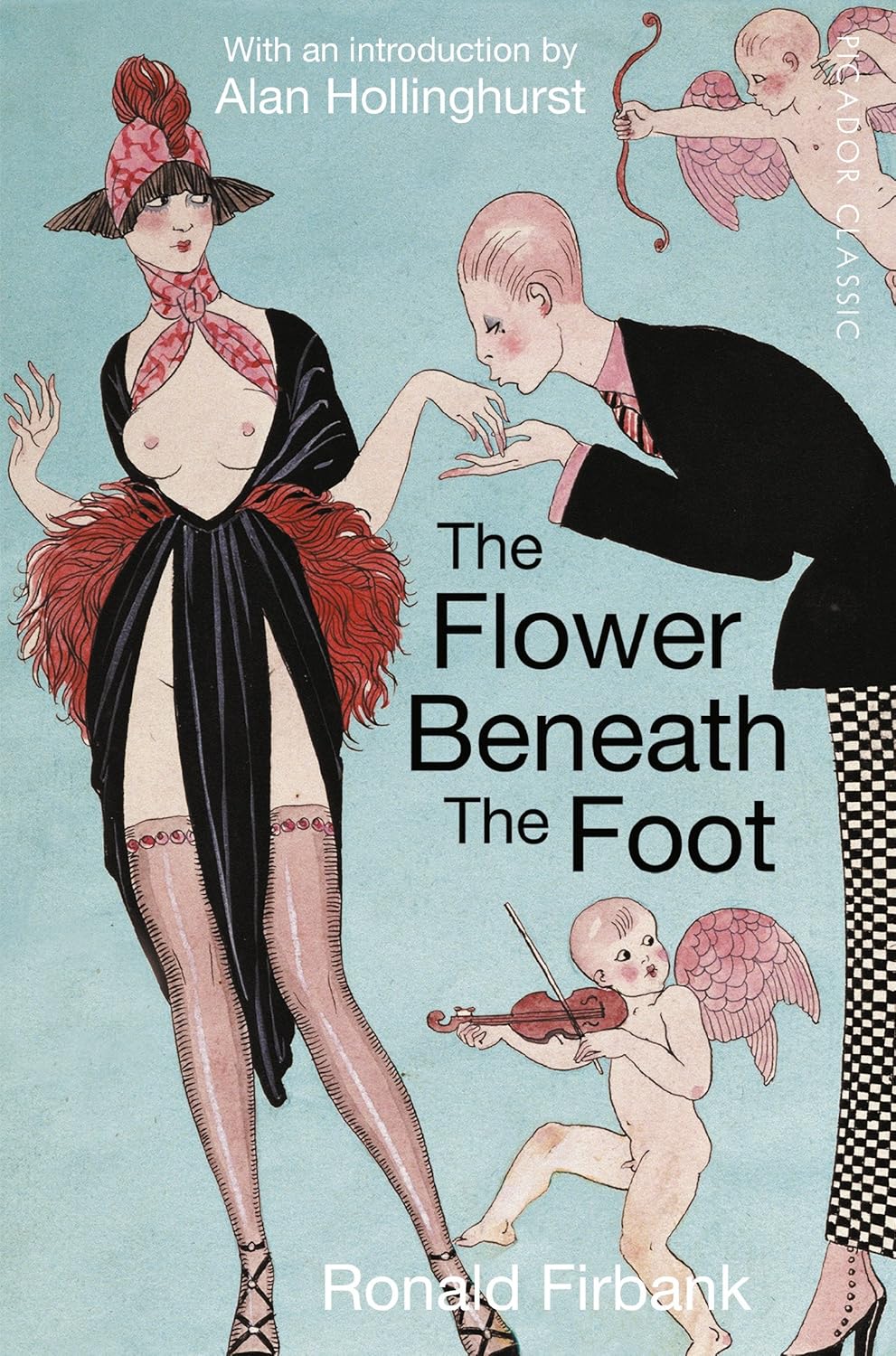
‘Niche’, on the other hand, is much more civilised. Niche suggests a small following, but it is one where the fans are graceful in their ardour. Niche creators are people like Ronald Firbank, Brigid Brophy, the musician Momus, whose memoir is simply titled Niche, and, I like to think, myself.
Cult authors often reject the world at large. They go off-grid and into jungles. They seek astral planes, menhirs, suspicious herbs and even more suspicious beards. Niche writers shave and take a folding chair.
A niche writer may be as strange and as difficult as a cult writer, but they still tend to enjoy the comforts of civilisation, with its libraries and its dry cleaners and its peacock-shaped coat hooks in the toilets (I am specifically thinking of the upstairs toilets at Café 1066 in the Priory Meadow Shopping Centre, Hastings).
Niche writers still want a place in the world, even if it’s just a rented room. Hence the wider meaning of niche: a little slot to fit into.
**
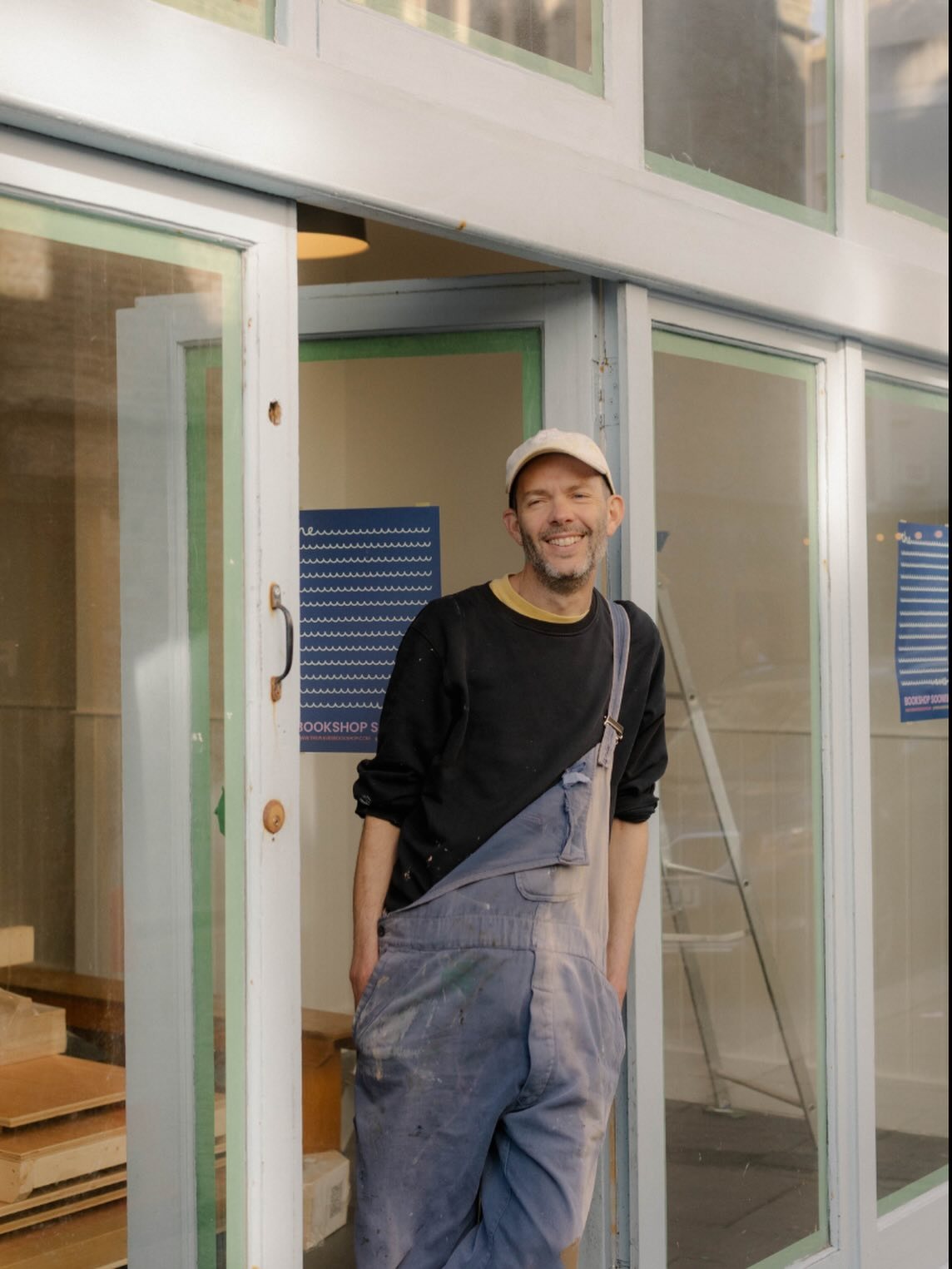
In this spirit, last week I hand-delivered copies of my nichebook to be sold at The Waves Bookshop, at 10 Claremont, Hastings. The Waves only opened three weeks ago, and I am overjoyed that it exists. It has an emphasis on new literary writing, classic gay books, arty magazines, Virginia Woolf books (obviously, given the shop title), and it also doubles as an art gallery. The owner is Jamie Atherton.
From the Waves Bookshop’s Instagram
If you are going to open a groovy new shop in Hastings, it helps to be called Amy or, if male, Jamie. There is the art, embroidery and stationery shop Bus Stop Studios, at 53 London Road, run by Amy Burt, where I get my cartridges of purple ink for my Kaweco fountain pen. Then there is the pleasant Folks coffee shop, a few doors closer to the sea at 45B London Road, which is run by Amy Dutton.
The argument for ‘Jamie’ as a male counterpart for ‘Amy’ recalls the London gender-flipped production of the Sondheim musical Company, which I saw in 2018. The character of Amy, the neurotic bride-to-be who sings the fast, hilarious showstopper ‘Getting Married Today’, was turned into a gay groom-to-be, Jamie. In that version he was played by Jonathan Bailey, who has since gone on to be the love interest in Bridgerton and the Wicked films.
Hastings HMV sells a Jonathan Bailey calendar, alongside ones for Taylor Swift and Harry Styles. I couldn’t see a Dickon Edwards calendar there, but there’s still time.
Company is also the musical that includes the song ‘Being Alive’, an earlier incarnation of which had the rather good title of ‘Multitudes of Amys’ . Now, when I think about the shops of Hastings, I think about multitudes of Amys.
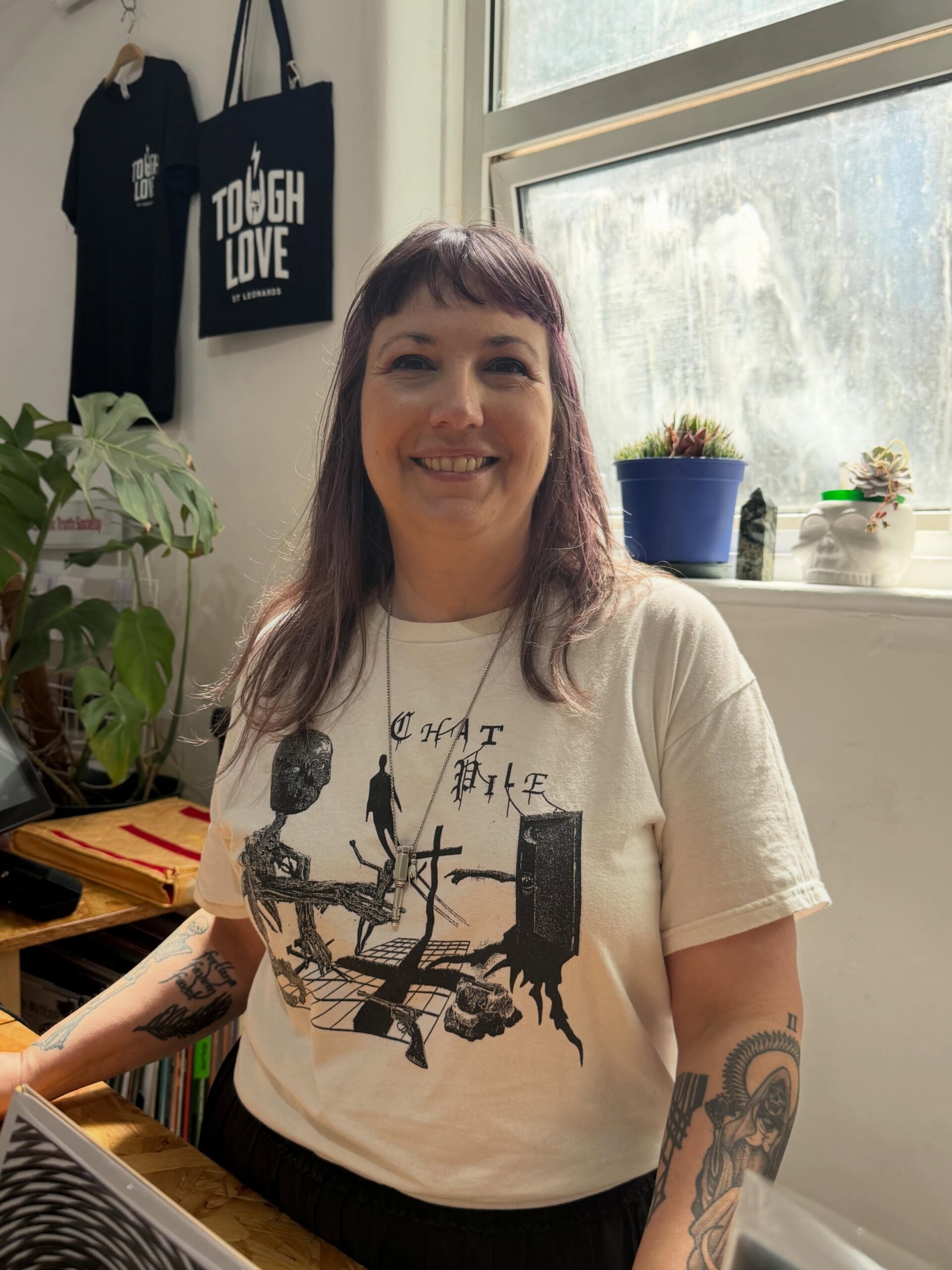
Tough Love Records, which has just moved from Bohemia Road to 8 London Road, even closer to the sea, is run by an Anja. So that’s the end of that theory.
This splendid emporium stocks a decent range of new CDs as well as new vinyl, and I still buy CDs, still loving their compact smallness, not to say their cheapness compared to new vinyl. Tough Love also has an attractive mini-café by the window, with sofas, where I can vent my overcaffeinated opinions about music.
From Tough Records’s Instagram
Anja Petitto is a fan of heavy rock, but she also loves Sparks, Abba and Beyoncé. While I was there last week, sipping my oat Americano, she played me the new Blood Incantation album, All Gates Open, which was singled out for praise in the latest issue of The Wire magazine.
One might think, given their name and their usual genre of death metal, the Blood Incantation album would have noisy rock songs about nasty things happening with corpses. In fact, the album is ambient and quiet and dreamy in the Brian Eno style. This is a healthy reminder that genre can be a departure point as much as a destination, and that a cult band can make a niche record.
**
Fans of niche writers do not hold conventions, they hold symposia.
On Friday 22nd May 2026, I was invited to London to speak at a symposium for Ronald Firbank, held on the occasion of the centenary of his death.
The venue was the Warburg Institute in Bloomsbury, a building affiliated with the University of London. When I joined the Institute to use its library a few years ago, the staffer on the desk recognised me from the 90s band Orlando. ‘I was a fan, back in the day’. She was perfectly matter-of-fact in saying this. Proof, perhaps, of my own niche status.
The main speaker was the novelist Alan Hollinghurst, whose talk on Firbank (‘The Firbank Century’) was a properly crafted literary piece, like a Henry James short story. One hopes he will publish it soon, so it can reach the wider audience it deserves.
My own talk was on the history of the word ‘Firbankian’, and how it was used in magazines like Vogue in the 1930s as a synonym for high camp. What’s particularly interesting is that the phrase ‘high camp’ itself didn’t exist in print until the 1950s, when Christopher Isherwood coined it for his novel The World in the Evening. In the 1930s and 40s, magazine writers who wanted to imply that sort of thing reached for ‘Firbankian’, and their readers understood.
A few days after this talk I received a kind email from the author Richard Davenport-Hines, who was in the audience. He said I had ‘just the right combination of frivolity and scholarly thought’.
The symposium featured several other speakers, a short film, and a rehearsed reading of Firbank’s play The Princess Zoubaroff, the cast of which included Miranda Richardson.
Everyone involved in the Firbank symposium was thoroughly fragrant. I chatted to Susannah Clapp, who went on to write up the symposium for The Observer. The fact that the Observer was interested shows that writing about a niche writer never feels like a personal indulgence. Writing about a cult writer, on the other hand, carries that risk.
**
Among the symposium’s external events was a walking tour of Firbank’s London hosted by Richard Canning. I love that Professor Canning not only edited the 2012 Penguin Classics edition of Firbank’s Vainglory but that he also performed in a student comedy troupe with Stewart Lee and Richard Herring in the 1980s; they were called the Seven Raymonds. These worlds are not so different. Firbank’s work is a form of strange and intelligent comedy in prose; Stewart Lee’s stand-up comedy features jokes about how he’s too strange and intelligent for most of his audience.
This is the ideal: to remain true to yourself, yet still appeal to the common niche-ness in enough people to make a living. Everyone feels niche at some point; it’s just another word for lonely.
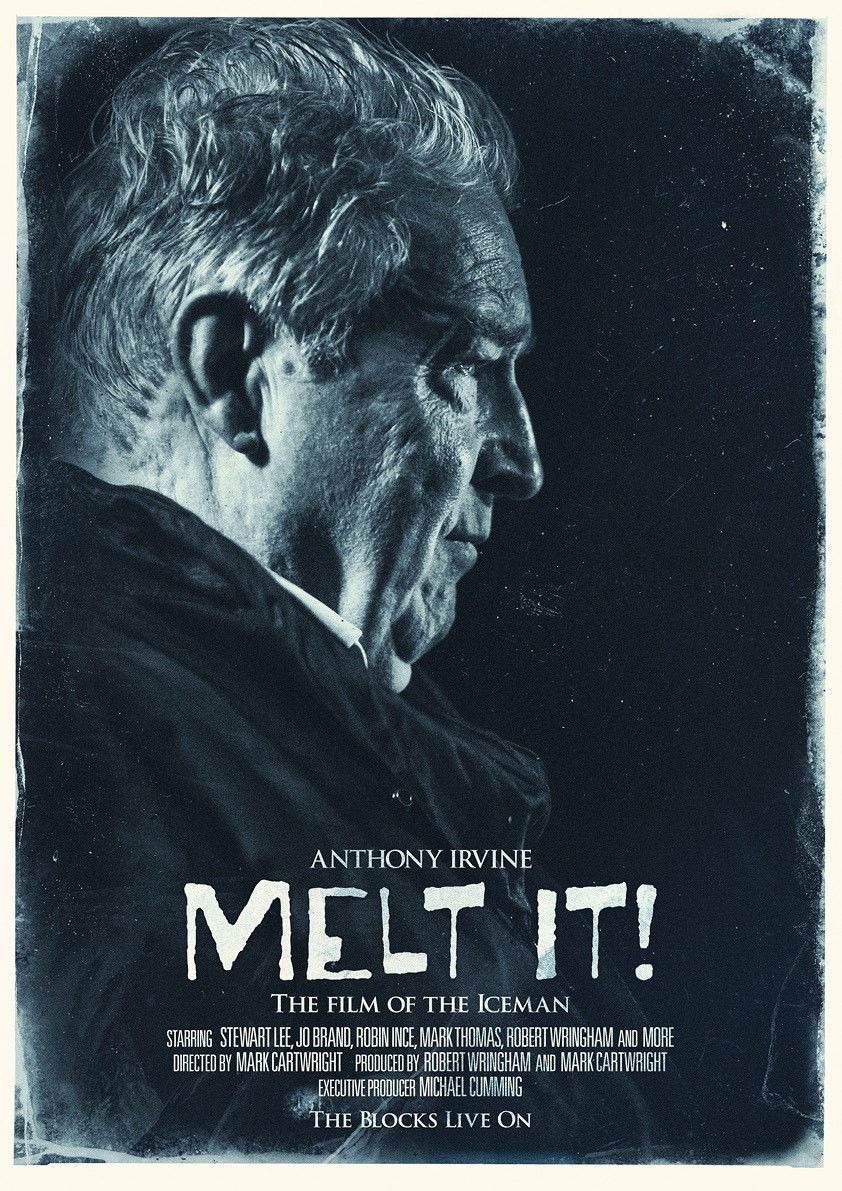
There is a new film on this subject that I’m keen to see. An enigmatic comedy performer from the 1980s has just had a documentary made about him: the Iceman, aka Anthony Irvine. His comedy act was to melt a block of ice onstage in various strange ways, and that was it. Anyone who saw him never forgot him.
The film features Stewart Lee and Jo Brand, among others, and is called Melt It! The Film of the Iceman. It is about to be screened at various UK venues over the summer, and I strongly recommend it. It makes perfect sense that one of the producers, Robert Wringham, is also the publisher of my diary book. He clearly believes in flying the flag for niche.
Melt It! will be screened at selected cinemas across the summer, including St Leonards-on-Sea (Kino-Teatr) on 19th July, and London (The Bill Murray) on 23rd August. For further info and other screenings, go to: wringham.co.uk/film
This online diary was begun in 1997. It is thought to be the longest running of its kind. The archive contains over twenty years of exclusive knowledge, all searchable and free to read without adverts or algorithms or clickbait. It depends entirely on donations by readers to keep it going. Thank you!
This piece is fairly long and is made up of several sections. It includes an account of my talk on Aubrey Beardsley at Brighton, along with tips on public speaking.
The trouble with dandyism is that it makes it hard to do anything that feels like Joining In. When I started the web diary in 1997, before the word ‘blog’ was invented, it was considered a strange thing to put one’s life on the internet full stop. Today, this practice is commonplace, if not the default. Almost everyone now thinks they are worthy of attention from strangers, whether it’s posting on social media or posting on Substack or posting on OnlyFans. And that all rather makes it harder for me to stand out.
If I were happier with my body I would show it off on OnlyFans. Instead, I am a writer, or rather a ‘content creator’, on Substack, which is the OnlyFans of the mind.
Still, on Sunday 7th June 2026 at around 10.45 a.m., I received fresh evidence that, if nothing else, my external appearance still stands out in the crowd, for better or for worse.
I was walking along the seafront here at St Leonards to meet some friends at the Goat Ledge beach cafe. There are benches along the promenade, set in sheltered alcoves. These alcoves are popular, needless to say, with certain social groups who like to Hang Out. The expected roll call of junkies, meth addicts, stoners and alcoholics, as well as bored teenage lads in the regulation black tracksuits and hooded tops.
As I approached one of the alcoves in my linen suit and tie, I saw a group of grizzled-looking older men in there. They were already staring at me. So I braced myself for the possibility of an unkind catcall.
One of the men shouted at me as I passed:
‘You look magnificent, sir!’
Then his friend next to him added:
‘You always do!’
I hope this means I am still capable of providing interesting content, if only as punctuation in the infinite scroll.
**
In the same way that I take too long to get dressed, I take too long to write. I envy people who can really churn out ‘content’. It may be true that fools rush in where angels fear to tread, but everyone prefers a fast fool to a slow angel, every time. Fast fools meet deadlines.
Today, a professional writer not only has to compete with other writers who are much faster, but with AI too. AI really should stand for Arrogance and Instantaneity. It makes mistakes, but it does so with speed and extreme confidence, which is really just a fig leaf for arrogance.
AI may be new, but the world has always respected speed and arrogance. Successful politicians get away with lies, and successful podcasters get away with rambling audio content that could really do with editing down. But both sets of people deliver these things regularly, and they deliver with confidence. And that’s why they do so well. Never mind the quality, feel the bandwidth.
All of which is a way of saying that I need to just get on with it and try and put the haste back into Hastings.
**
Recently, Tribune magazine published a flattering article about my book Diary at the Centre of the Earth Vol 1, now available in a new printing for 2026. The article, ‘Samuel Pepys Who?’ by Claire Biddles, quotes several lines from the diary book, including this one:
“It’s always important to go where you’re invited. That way it’s someone else’s fault.”
This was the case on Saturday 28th March of this year when I was invited to give a talk about Aubrey Beardsley at Brighton Sixth Form College. Beardsley was a former pupil there, from the time when it was Brighton Grammar School. I was contacted out of the blue by one of the current staff there, Alison Cousens, whom I once knew from my indie band past. She was in the 1990s Sarah Records band Brighter.
It turned out that Alison was looking for someone to give a talk on Beardsley at the college’s community history festival. On the internet she stumbled upon my essay, ‘“Donald! Susan! Ronald! Brigid!”: The Camp Afterlives of Aubrey Beardsley’ on the website of the Aubrey Beardsley Society.
She told me later in a phone call: ‘I thought, “I wonder if that’s the same Dickon Edwards?”’
There are in fact at least two other Dickon Edwardses, a barrister and a deputy headteacher. But no, this Aubrey Beardsley one was indeed the indie band one that she remembered. So she got in touch.
On the phone I was happy to tell Alison C that in recent years I had reviewed a book about her old band and Sarah Records for The Wire magazine. I added that the magazine had printed a picture of her and her Brighter bandmates to go with the piece. It was a very cute photo of the three of them in their early 1990s youth, jumping about in a field, very much embodying the Sarah Records aesthetic of aloof, child-like adults.
‘Oh, I hate that photo’, she said.
**
The talk was unpaid, though it did cover travel expenses. Given my slow work rate, and my current low income, which is low enough to necessitate checking in with Hastings Job Centre every fortnight, I should probably hesitate before accepting unpaid work. But I said yes. It was for a free community festival, after all. And I like Alison C. And it’s nice to feel important, particularly in Brighton, one of my favourite places.
And although accepting the job meant spending many unpaid hours doing research and lurking in libraries and archives, because I like to do a good job with my talks, that’s my idea of a good time anyway.
I made a special trip to the Sussex Keep archive in Falmer, in order to look through copies of Beardsley’s old school magazine Past & Present, which published his early work, and which carried reminiscences of him in later issues. When Beardsley was ‘cancelled’ around the time of Oscar Wilde’s arrest, in the sense of losing much of his income through being fired from The Yellow Book and having his reputation tarnished by association with Wilde, the school magazine still carried articles in praise of their former pupil. That said, they only referred to the Salome book without mentioning Wilde’s name, which was a common thing to do in the years after Wilde’s imprisonment.
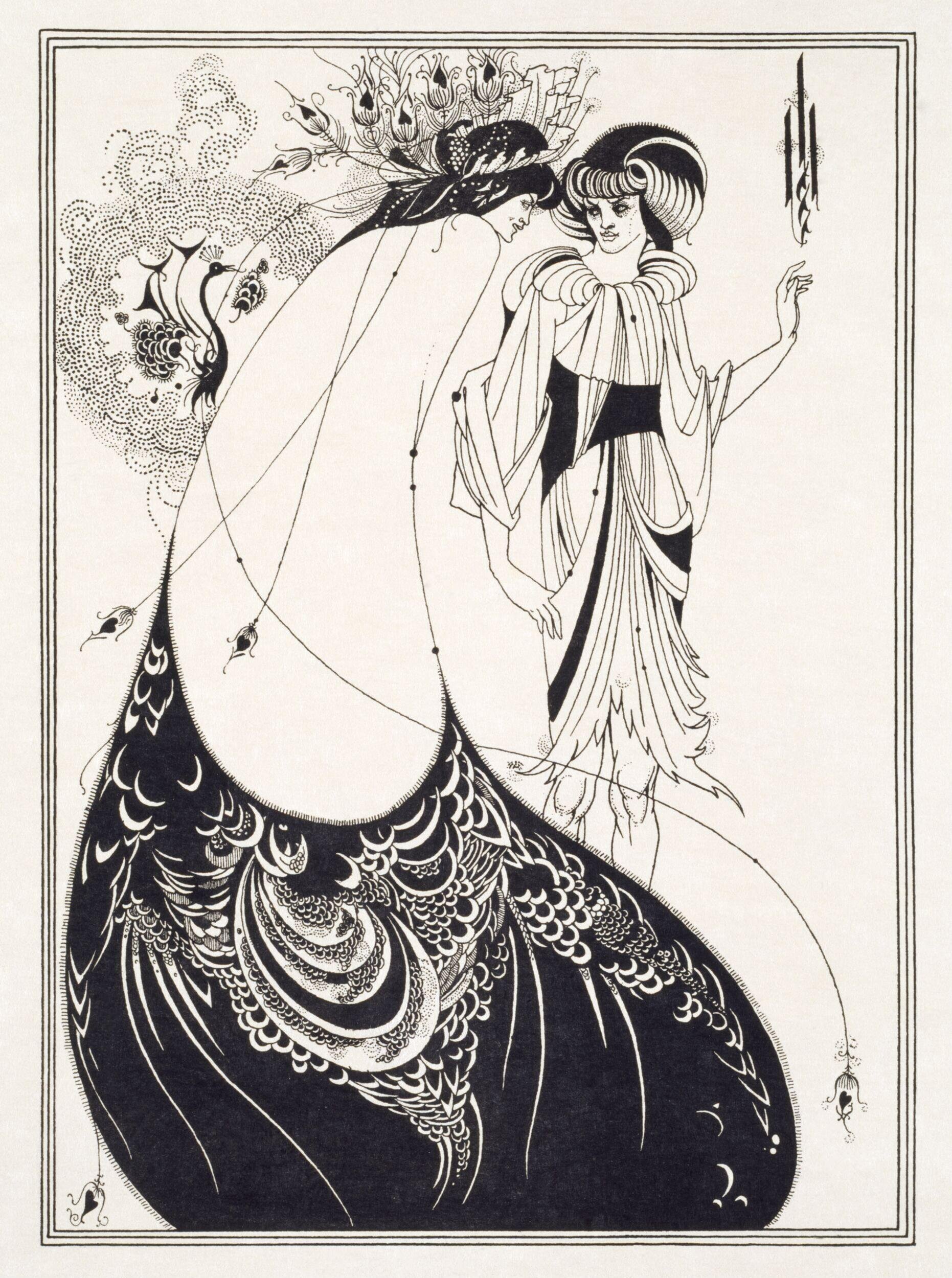
I also consulted several books on Beardsley, particularly the sumptuous two-volume Aubrey Beardsley: A Catalogue Raisonné by Linda Gertner Zatlin. Zatlin’s book has a wonderful early sketch by the young Beardsley of the railway viaduct near Brighton London Road station, which I travelled over in my approach to the city. The viaduct is built on a long and graceful curve, not unlike the one in Beardsley’s Peacock Skirt.
I was curious to know which single artwork is Beardsley’s most reproduced; his Mona Lisa. Zatlin suggests several contenders, all from the illustrations to Oscar Wilde’s 1893 play Salome. One is the The Dancer’s Reward, which is the one where Salome holds John the Baptist’s severed head on the plate, another is The Climax, whereSalome floats in the air for no good reason, and kisses the same head, whose blood drips down to form a white lily.
The Dancer’s Reward
The Climax
There’s also The Peacock Skirt, which is Beardsley at his prettiest and least grotesque, as used as part of a trendy London flat’s decor in the film Carry On Loving.
The Peacock Skirt
EH Gombrich’s The Story of Art favours The Toilette of Salome, in which Salome is waited on by a Pierrot clown figure, which is not in the play at all. He just really liked drawing Pierrot clowns.
The Toilette of Salome
I managed to mislabel one of my slides, due to using Google Images, a mistake I owned up to when giving the talk. John and Salome is mislabelled on several parts of the internet as ‘Salome with her mother Herodias ’. There are two lessons right there. One, that Beardsley’s figures are still deemed confusingly androgynous even today, and two, that Google is not to be trusted. Stick to authoritative books.
John and Salome
I was keen to make some pop cultural references, so I brought in the Beatles’ Revolver and Sgt Pepper sleeves. I also referred to Harry Styles’s hosting of the 2019 New York Museum of Metropolitan Art’s Met Gala, the theme of which was Susan Sontag’s essay ‘Notes on Camp’. Beardsley was featured in the accompanying exhibition that year, as he is one of Sontag’s examples. I decided not to show one of the drawings that the Met had on display, as it’s one of the naughtier ones, from Lysistrata. The talk was at a family-friendly event at a school, after all.
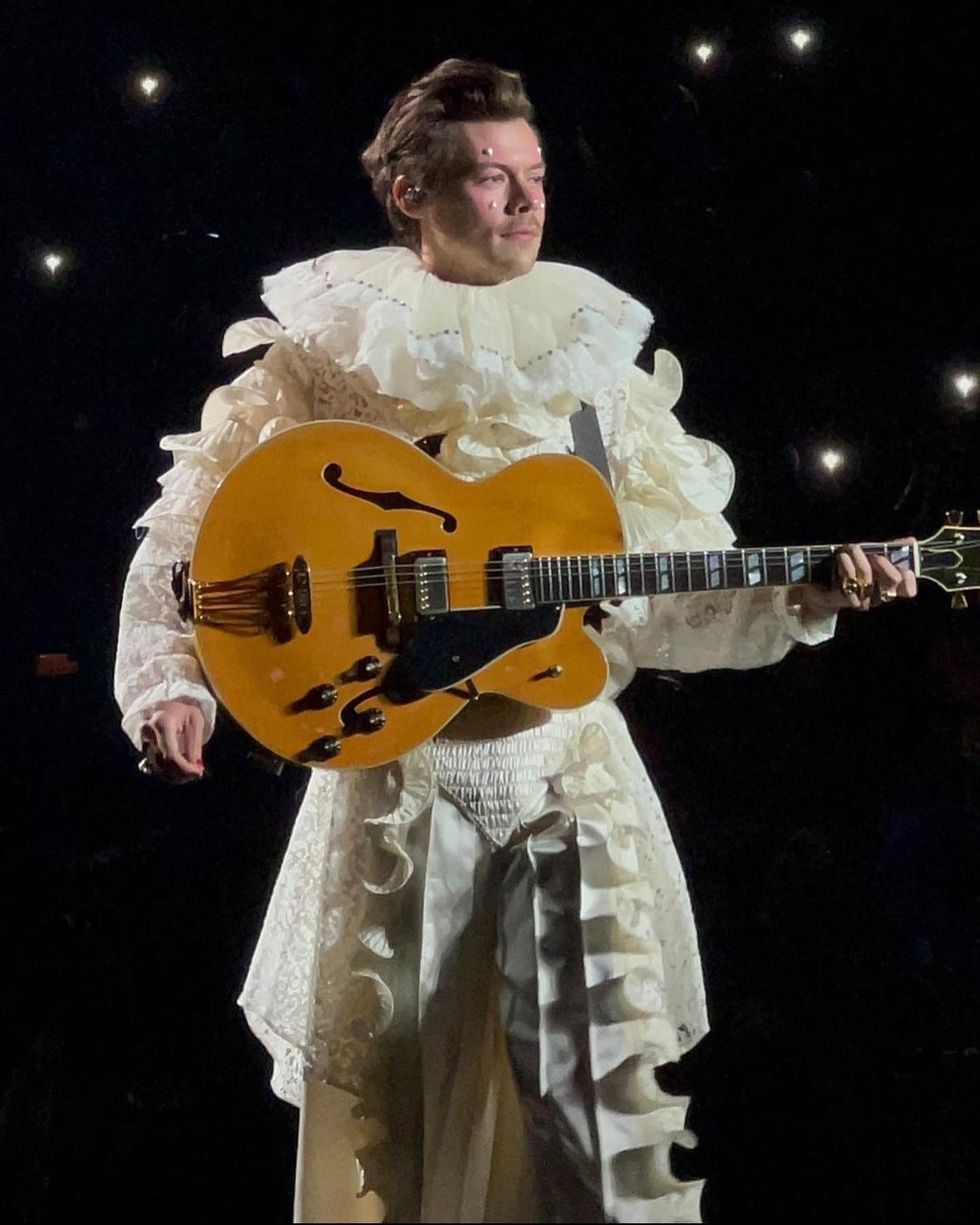
Harry Styles also featured in my talk for his wearing of a Beardsley-influenced fashion suit onstage, as well as a costume based on Pierrot the Clown, another of Beardsley’s favourite themes. Soft masculinity; masculine otherness; camp masculinity, that sort of thing.
Harry Styles on stage
Beardsley, Front end-paper design for Pierrot’s Library, 1895
The argument of my talk was that Beardsley was the most important man in Brighton, in the sense of his spirit being there, and by his representation by a plaque on his birthplace and by a group of exhibits in Brighton Museum, which are currently part of their ‘Queer the Pier’ display. Beardsley was not only born and schooled in Brighton, but because of the influence of the Royal Pavilion on his art, and for his embracing of sexual otherness, camp exoticism, and alternative arts and alternative lifestyles, he was, and is, Brighton personified.
While writing the talk, I used a productivity tool which I find useful: Zoom Pomodoro writing. You meet other struggling self-employed writers or academics on Zoom (or Teams) and have 25 minute sessions of silent work together, while visible (but muted) on webcam. Then you take a 5 minute break, in which you declare what progress you made, and what your ‘nano goal’ for the next 25 mins will be. And so on. It’s cheaper than a writing retreat, and easier to fit into your day.
On one of these sessions, I told one of the other academic Zoom people what I was writing. I should mention that this person was a thirty-ish woman from Syria, whose field was architecture.
‘I’m working on a talk about Aubrey Beardsley’, I said to her.
‘Who’s that?’
‘He was a British Victorian illustrator. Very popular in his time, very influential since. He’s often spoken about in connection with Oscar Wilde.’
‘Who’s Oscar Wilde?’
‘Ah. Right. Well, Oscar Wilde was an Anglo-Irish Playwright from the Victorian age, very popular in his time. Still is now. Perhaps not with everyone. Well, I’m also going to talk about how Aubrey Beardsley connects with… Harry Styles!’
‘Who’s Harry Styles?’
‘Ah. Well, Harry Styles is a British pop singer of the current moment. Um… (sheepishly) Very popular in his time. Which is now. So… perhaps not so popular in Syria. Well, anyway, I’m mostly going to talk about Aubrey Beardsley’s connection with Brighton.’
‘Oh Brighton! I’ve heard of Brighton! I had sunstroke there!’
I learned a valuable lesson from this. Celebrity is overrated. Places are the true common ground.
**
I practiced the talk a few days in advance, with my kind friend Victoria R giving me feedback. Victoria also accompanied me to Brighton and helped me run a stall at the college’s community festival, at which I sold my book.
Here are some tips on speaking in public. Some of the following are from Victoria, some is feedback I have had from others, some is from my own experience.
Write your talk as a script, but don’t read from it verbatim. Put it on a stand and use your hands to illustrate the talk. Use it as a safety net to keep you on track and when your mind goes blank. Print it out in large font and treat it as a serving suggestion.
Write 100-125 words for every minute of the talk. If using slides, use one slide for every 2 minutes of the talk. This works out at 200-250 words per slide.
Forget nerves, plural. Rediscover your nerve, singular.
Slow your speech down. Writing should be fast, speaking should be slow.
Speak in haikus, not in sagas.
Pause more. Breathe more. Breathe at every comma and full stop. Give the words more weight. Give people the chance to digest your words.
Pick a well-known speaker that you admire and play them, like an actor. This is just to get started: your own self will soon come through.
If you need glasses or contact lenses, take them out for the talk. This turns the audience into a blurry single entity. You can now look at them, without looking them in the eye. This helps with nerves. Dusty Springfield used to do this.
I have read elsewhere that one tip is to imagine the audience as a person that you want to have sex with, and so must seduce. Although I can see the reasoning, it’s probably best not to do this when giving a talk at a school.
Regarding a follow-up Q&A, the ideal format is to do what Quentin Crisp used to do: supply blank postcards and small pencils under the audience’s seats. They’re sometimes called ‘golf pencils’ or ‘baby shower pencils’. At the start of the talk, ask the audience to write down their questions on the cards. Then get the cards passed to you at the end of the talk, and answer accordingly. This helps people who don’t like speaking up, or those who have several questions. It also makes for a more polished event, as you just dismiss any question you can’t or won’t answer.
If you can’t do that, and have to do a Q&A with audience members speaking, I have one tip that was passed on to me by a lecturer at Birkbeck. By a male lecturer, in fact, which is relevant:
Always try to take your first question from a woman. Men in an audience are, generally speaking, more likely to use a Q&A to voice an overlong personal opinion rather than ask an actual question. The only other people to ask questions after that, if there’s any time left, tend to be other men with their overlong podcast-like opinions, who now feel emboldened. So always start with taking a question from a woman. And then have a man after that. They’ll be fine, the men.
**
I did the talk.
Photo by Victoria Redfern
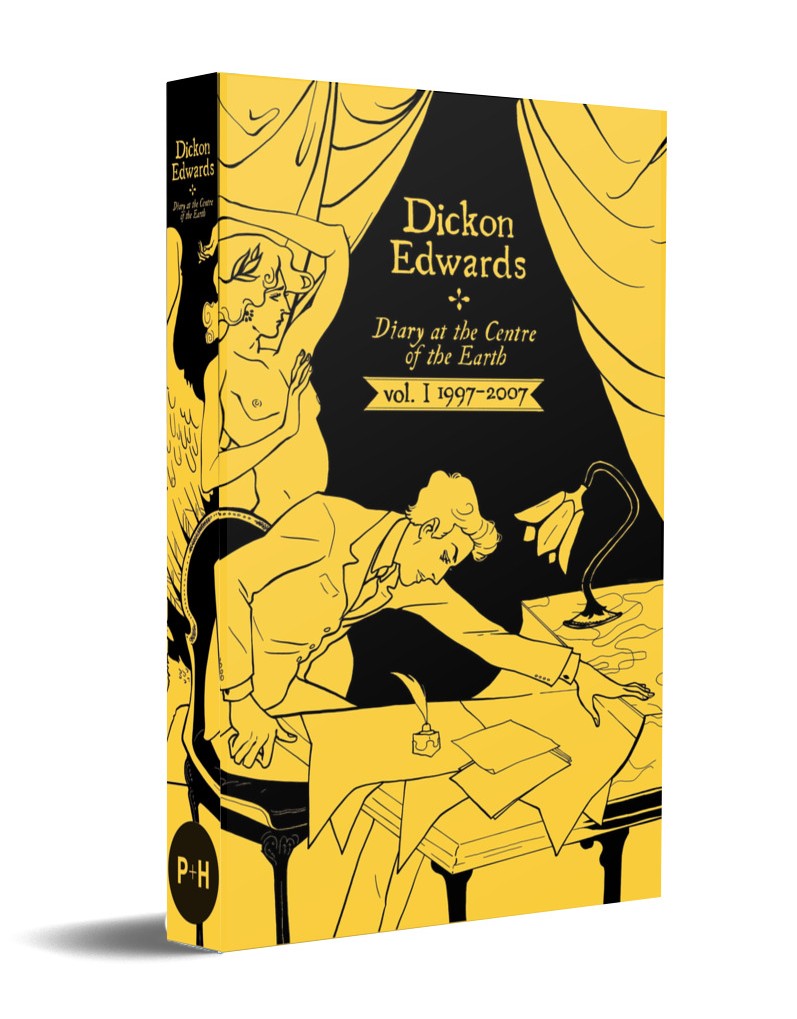
I think it went okay. I sold all the books I had brought with me, so that must mean something. The diary book is not even about Aubrey Beardsley. It does, however, have a cover that’s very much a pastiche of Beardsley’s designs for The Yellow Book.
Before leaving, I received a gift from Alexia Lazou, who curated the Beardsley display at Brighton Museum. She was wearing a wonderful black and white dress based on Beardsley’s art. Her gift was a bar of soap in the shape of a lemon, made by the Menton Côté Citron firm, from Menton in France, close to the Italian border. Menton is where Beardsley died from tuberculosis. The plaque on his birthplace at 31 Buckingham Road, near Brighton station, uses the Italian spelling ‘Mentone’, as confirmed when Victoria R and I visited the plaque after the event.
Photo by Victoria Redfern
The plaque dates from 1927, when Brighton council put up its first series of plaques, all designed by Eric Gill, commemorating people with a Brighton connection. They also chose Charles Dickens, George Canning and William Gladstone, and Beardsley’s own headmaster, EJ Marshall, who encouraged the young Beardsley in his art. The Beardsley plaque mentions his time at the Grammar School and calls him the Master of Line. It also reminds the viewer of his shockingly short life: born August 1872, died March 1898. He was just 25. Thirty years later, when the plaque was put up, his mother was still alive; she unveiled it at a ceremony.
While writing this account, I was listening to the new Harry Styles album, Kiss All the Time; Disco, Occasionally. On songs like ‘Aperture’, ‘American Girls’, and ‘Paint By Numbers’ there’s a bittersweet sense of soft masculinity and vulnerability, and of enjoying life while you can. Liam Payne, who was one of Styles’s bandmates in the boyband One Direction, suddenly died in 2024 at the age of 31. One song on the album, ‘Paint By Numbers’, seems to be about him.
“Oh what a gift it is to be noticed”, sings Styles, with clear mixed feelings about fame. And, as I found out, there are plenty of people who go about their lives completely unaware of the names Aubrey Beardsley and Harry Styles, so fame is all relative anyway.
Best just live, put out work while you can, and let others decide if it’s worthy of notice.
**
This online diary was begun in 1997. It is thought to be the longest running of its kind. The archive contains over twenty years of exclusive knowledge, all searchable and free to read without adverts or algorithms or clickbait. It depends entirely on donations by readers to keep it going. Thank you!
NOTES
Diary at the Centre of the Earth Vol 1 is available to buy from poniesandhorsesbooks.com. The line about going where one is invited is in the entry dated Friday 9th January 2004.
I took the connection between Beardsley’s Pierrots and Harry Styles’s Pierrot stage costume from a talk by Samuel Love at the event AB 150: The Artist Resurgent, St Bride Foundation, London, 21st August 2022.
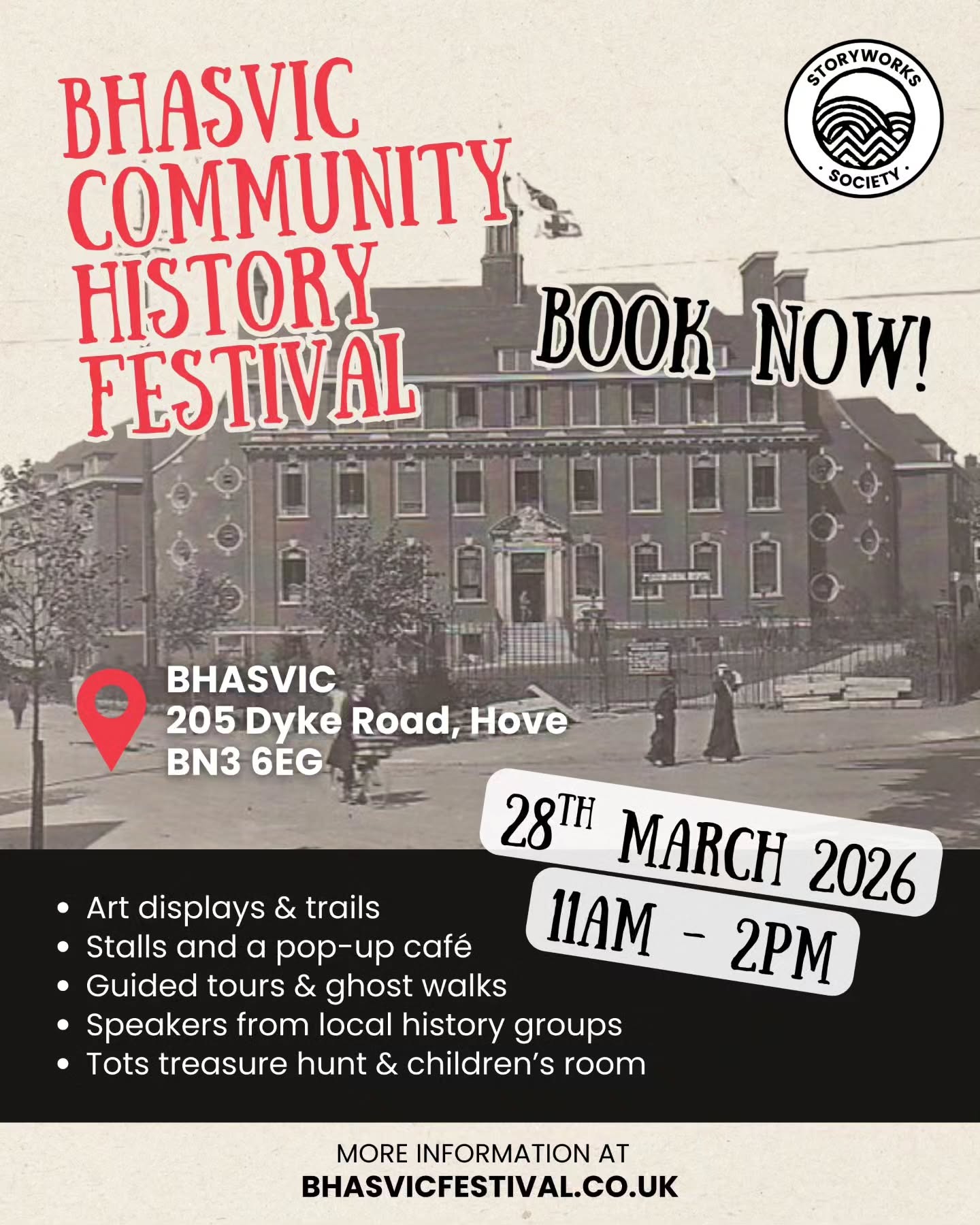
This Saturday 28th March at 1pm I will be at Brighton 6th Form College’s Community History Festival, to give an excellent talk about the Victorian artist Aubrey Beardsley.
Beardsley was a pupil of the college from its time as Brighton Grammar School. I will be explaining how his work relates to Oscar Wilde, the Beatles, Harry Styles and Heartstopper, and will show how this is all the fault of Brighton.
I will also have a stall at the festival to sell copies of my diary book, which has a cover influenced by Beardsley.
The festival is open to the general public and is free. It takes place from 11am to 2pm at the BHASVIC main site, 205 Dyke Road, BN3 6EG. More info at www.bhasvicfestival.co.uk
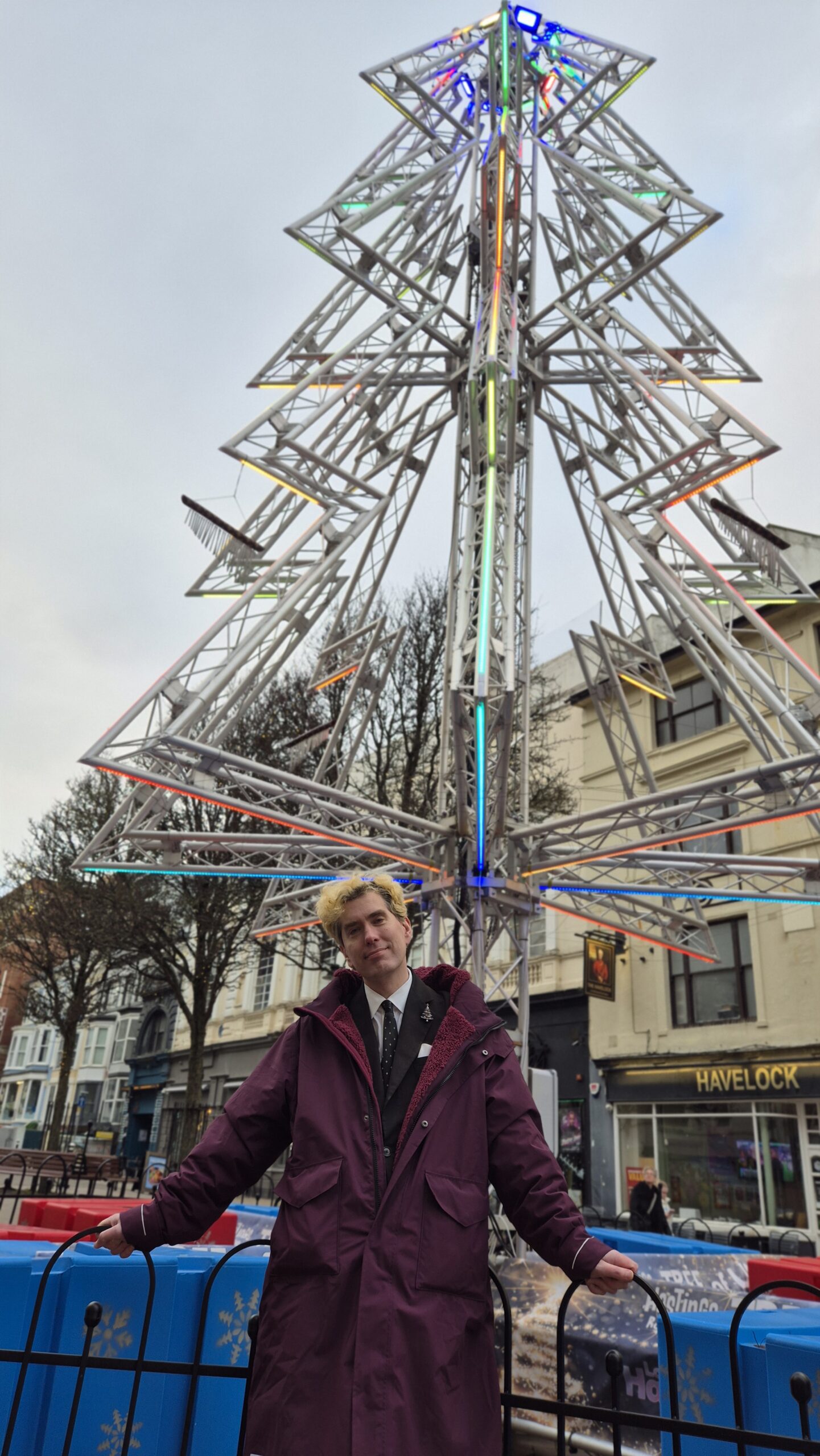
DE, Hastings, 28 December 2025. Photo by Victoria Redfern.
For some years now I have marked the Christmas period with a new photo of myself next to a Christmas tree. This year the choice was obvious.
In early December 2025, in Hastings, UK, where I currently live, a new aluminium tree-shaped structure appeared in the town centre. Decked with wind chimes and changing electronic lights, the Alu-Tree became something of a local conversation piece.
This object, it transpires, was a collaboration between the civic organisation Love Hastings, which provides improvements for businesses in the town centre, and the Hastings firm Metalworx, who normally make stages for rock festivals. Love Hastings wanted a solution to the problem of traditional trees being damaged every year by the strong coastal winds. They approached Metalworx, who unbeknownst to them had just made their first metal Christmas tree, an indoor one for Selfridges. So it was a fortuitous convergence of local needs, local expertise, and available funding.
Lovers of traditional leafy trees were still catered for: there was one in the nearby Priory Meadow shopping centre, which is much less exposed to the weather. Nevertheless, when the aluminium tree was installed it was met with adverse criticism on social media. On Facebook the tree was deemed ‘soulless’, ‘sterile’, and an ‘eyesore’.
I have to admit the tree’s daylight incarnation is inferior to how it looks at night, as shown in this video by Victoria Redfern:
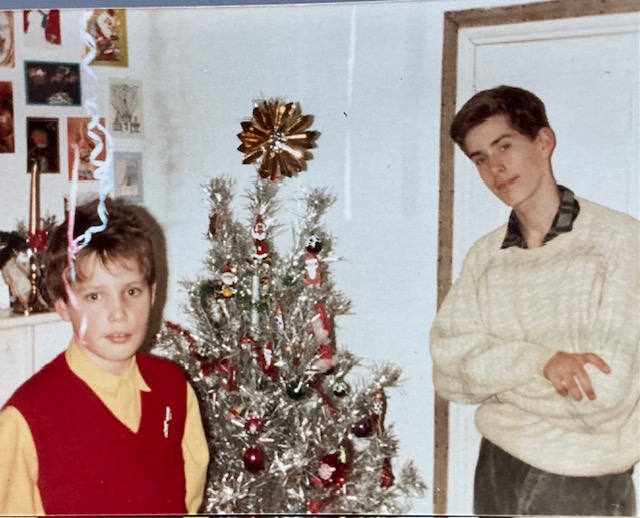
But I do like the tree’s daylight look too. It reminds me that I grew up with a silver artificial tree in my parents’ home, one made of branches of tinsel glued to steel poles, somewhat resembling glittery feathers. Each branch had to be carefully unsheathed from a cylinder of stiff brown paper, then slotted into the holes of a central pole, starting from the base up.
This assembly process was carried out every year by myself and my brother, and was hugely enjoyable. It had all the pleasure of a kit of Lego or Airfix, but with none of the butchness. The tree was sustainable in the current sense, too, lasting our entire childhoods. Here’s me and my brother with the tree in Suffolk, during the mid-1980s:
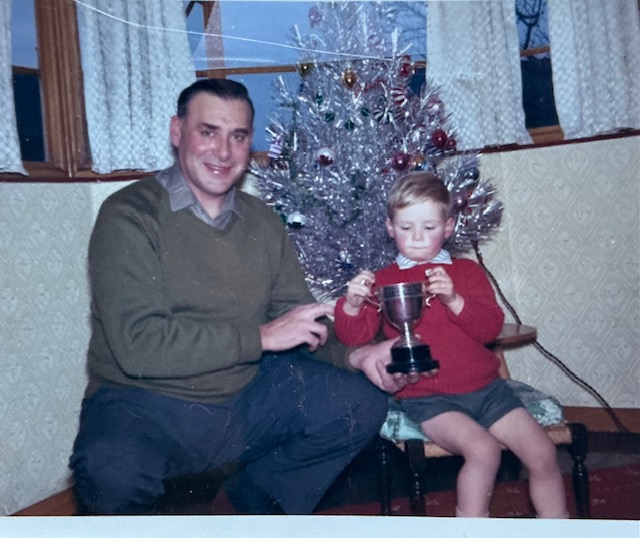
Yesterday I was speaking to my mother on the phone about writing this piece, and she revealed that my childhood tree had been her childhood tree too. It was made in the 1950s for a Selfridges display. After Christmas, Selfridges sold off the trees to staff and account holders. Mum’s mother was an account holder, and she bought one. The tree was used, we think, for about fifty Christmases.
Here’s the same tree in the early 1960s at my mother’s childhood home in Gravesend, Kent. In front of the tree are my grandfather John and my cousin Milton:
In this year’s tree photograph I am wearing my own practical solution to coastal winds: a lovely new Parka-style weatherproof coat – my mother’s Christmas present – as made by the Red company. The colour is Rich Burgundy: I no longer drink alcohol but I can still enjoy the aesthetic.
The coat is big enough for me to wear a suit and tie underneath, and indeed to show off my lapel brooch, which happens to be in the shape of another Christmas tree. I like the visual pun of a tiny tree in front of a huge one. Both fake trees celebrate artificial colours and strong looks, and both are liable to invite comment. I can relate.
One local newspaper called the aluminium tree ‘modernist’. I would call it camp modernist, the concept I researched as part of my PhD. Paul Baker’s book Camp! argues that as a season Christmas is (even) camper than Hallowe’en: his prime example is the tradition of the Rockettes Christmas dance show in New York.
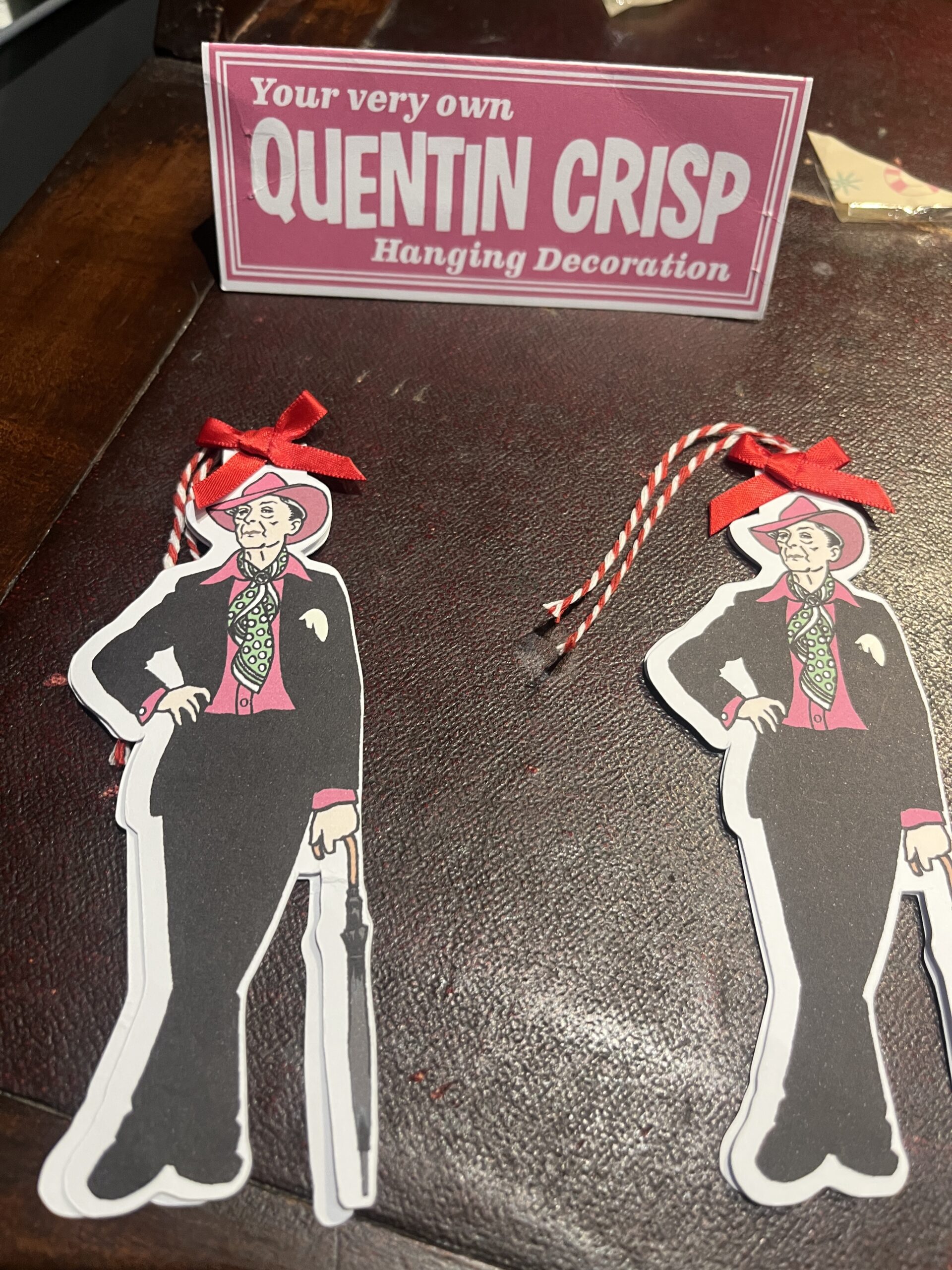
Christmas is also the birthday of the camp dandy icon Quentin Crisp, who delivered Channel 4’s inaugural Alternative Christmas Message in 1993. This Christmas I was given two Quentin Crisp tree decorations by two separate friends:
I’ve been called a Quentin Crisp imitator on occasion, who in turn was called an Oscar Wilde imitator, who in turn was called a J-K Huysmans imitator. All is creative imitation of a kind, like the tree. Dandyism is cosplay as oneself, but with a sprinkling of role models in the mix.
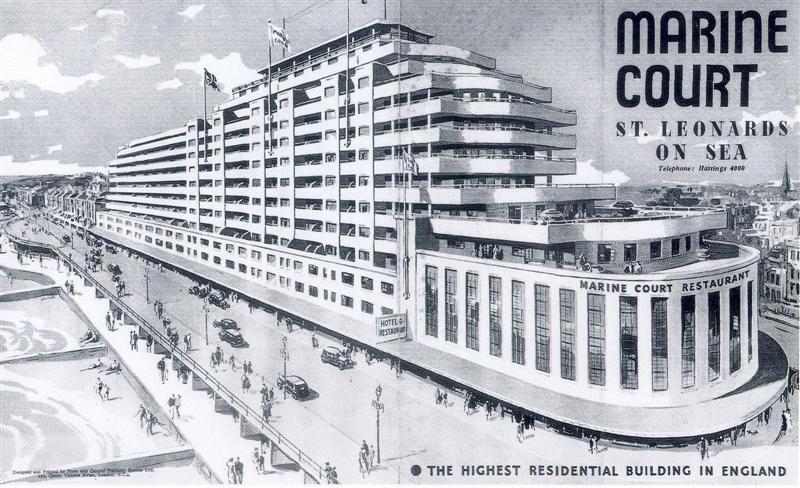
As camp modernist structures go, one might compare the Alu-Tree to Marine Court, the 1930s apartment block on the nearby seafront, built to imitate the Queen Mary ocean liner:
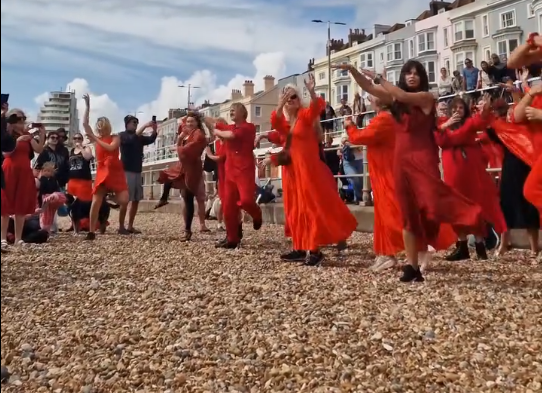
A block of flats impersonating a boat; an aluminium frame impersonating a tree. Hastings does seem to attract dressing up. There’s Pirate Day, Jack in the Green, the Frost Parade, and in summer 2025, a massed gathering of Kate Bush impersonators on the beach. What’s the collective noun, I wonder: a Dreaming of katebushai?
This still from a social media video of the event manages to include Marine Court (left, background), looking on approvingly. ‘You be Kate Bush, I’ll be the Queen Mary’.
The katebushai all wore floaty red dresses and recreated the dance from ‘Wuthering Heights’ in sync with the music. The official event was actually meant to take place high up on the West Hill, which makes sense, but poor weather the previous day had made the ground so muddy it had to be cancelled by the hosts at the last minute. Nevertheless, some of the dancers quickly organised an unofficial, guerilla version of the event, on the beach by the Goat Ledge café. This, I feel, is the true spirit of Hastings: creative imitation as an unstoppable instinct.
Given the rise of what people are calling ‘AI Slop’, where fake images and videos can be made online too easily, too anonymously, and too superficially, the meaning of physical experiences has now taken on a new level of intensity and value.
On a trip to London recently, I saw an advert on the tube encouraging people to retrain as plumbers. The tag line went something like: ‘Because AI can’t unblock a sink’. That’s hard to argue with.
AI ‘deep fake’ videos are certainly getting more and more uncanny, with all that word’s connotations of unease and fear. I used to think that my own physical speaking voice, which has a lateral lisp, was beyond AI imitation. But in 2025 I saw a whole YouTube channel of fake Slavoj Žižek lectures that convincingly imitated the philosopher’s own lisping voice:
Deep Fake AI Žižek:
The real Žižek, to compare:
In the deep fake video, the words spoken are not written by Žižek. They appear to be an original text by the anonymous person behind the YouTube channel, who probably used AI for that too.
The real Žižek has pointed out on his Substack (which for a while people thought was fake!) that, although the AI’s lisping voice is convincing, the videos fail to mimic his manic hand gestures, his sniffing, his stammering and other uniquely human tics. But perhaps it’s only a matter of time before AI can imitate those as well.
The question that bothers me is: why would someone go to the trouble of making a fake Žižek channel in the first place? I suppose it’s like the answer to why climb Everest: because you can. Because it’s there. In fact, AI creation offers a far quicker fix of pleasure than mountaineering. I assume the YouTube person went to the trouble of making the AI videos because it’s no trouble at all. Which, of course, is extremely troubling.
The irony is that deep fakes are a shallow thrill. There is deeper and more lasting pleasure found in offline fakery, with ‘real’ fake Christmas trees, ‘real’ fake ocean liner architecture, and ‘real’ fake Kate Bushes.
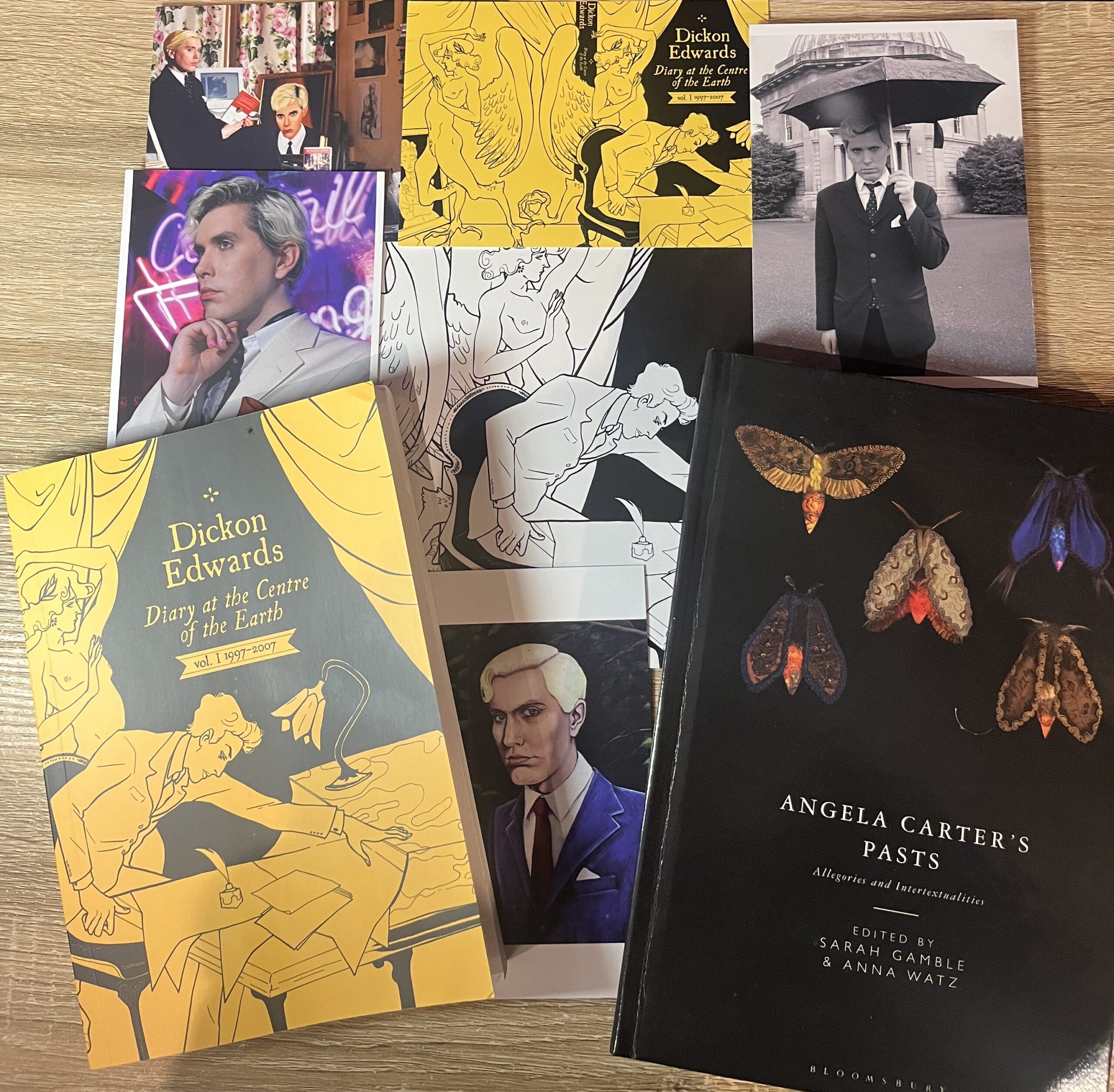
For my part, 2025 was the year I became a fake version of my own younger self. Young Dickon Edwards Cosplay. I authored a physical book, being an edited collection of my diary entries from the 1990s and 2000s: Diary at the Centre of the Earth, Volume One (P&H Books).
In fact, I had two books out in 2025 if you count the collection of academic essays Angela Carter’s Pasts: Allegories and Intertextualities (Bloomsbury Academic). My contribution for that book was an investigation into the making of Carter’s 1984 radio play about Ronald Firbank, A Self-Made Man. I was required by the book’s editors to conform to the Bloomsbury Academic house style. This meant using an author-date system for references and writing in a way that made use of my PhD training. More imitation, one could argue. Linguistic cosplay.
Meanwhile, my diary book’s bright yellow cover, by Lawrence Gullo, was commissioned by the publisher Rob Wringham as another example of creative imitation. It was a pastiche of Aubrey Beardsley’s 1890s covers for The Yellow Book, channelled through Mr Gullo’s own 21st century manga-esque drawing style. The social media platform Bluesky automatically censored pictures of the book cover as obscene. It isn’t, but Beardsley would have approved.
The yellow spine means the diary book tends to stand out on any shelf, as I tend to do in public, for better or worse. Whatever you think of the book or me, at least we’re easy to spot. But all the credit for the book’s physical appearance is really due to Mr Gullo and Mr Wringham. Publishers make books, authors just provide the raw material inside.
My own author epiphany was that all properly published books are the results of arguments. The author has argued with the publisher or editor about everything from the cover to possessive apostrophes, with many messages going back and forth, until both are satisfied. I can only apologise to Mr Wringham for being so fussy, and indeed, so slow and so late.
My first two author events for the diary book, in London in October, had to take place without any actual books. This was due to aberrant behaviour by the courier company, though I’m hardly in any place to judge others for human eccentricity.
We had the parties in London anyway. I was given gifts and drinks and food and flowers, making the events less like book launches and more like Book Showers. And the author turned up in person, which was the main thing. I am, after all, a limited edition object of one. Books are just an author’s stunt doubles.
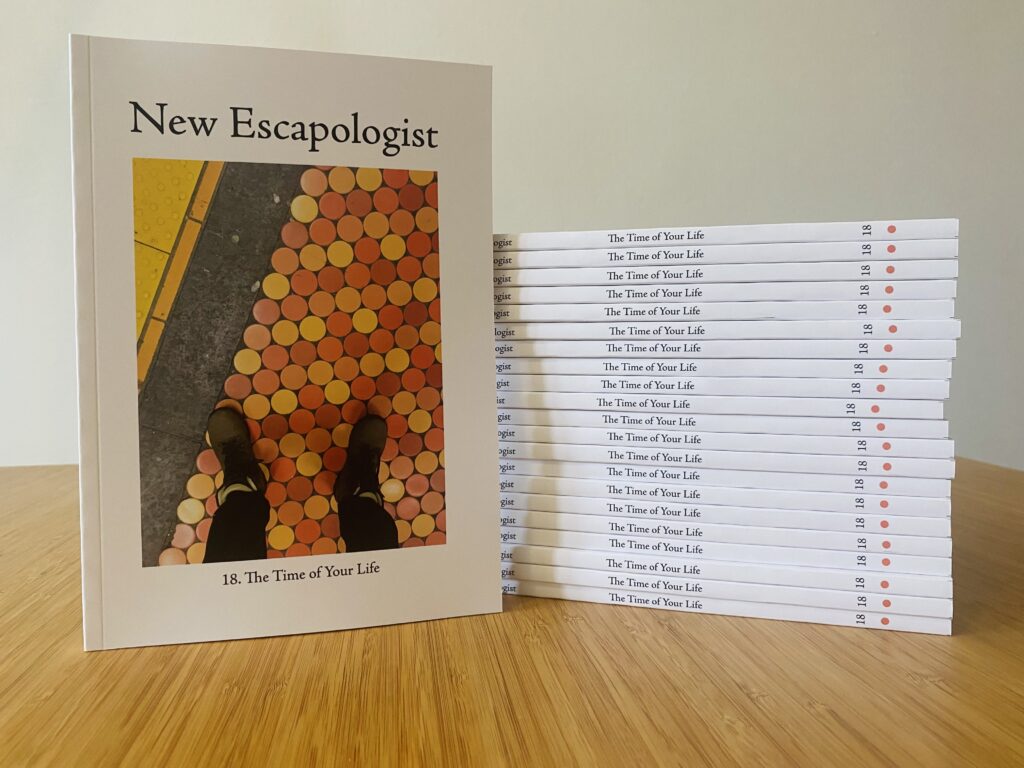
Thankfully I had some Emergency Merchandise to sell and sign. There were copies of the beautiful new issue (#18) of the New Escapologist journal, which includes a new interview with me, with lots of quotable lines to cut out and keep. The journal also has a fascinating interview with August Lamm, an anti-computer activist whom I admire:
We also had the new postcards of myself that were made to go with the limited edition Kickstarter copies. I took the idea from seeing limited editions of manga comic books that came with postcards. I really wanted a stash of them for myself, though, as I regularly send letters and cards in purple fountain pen ink. And I love getting replies, usually handwritten, but sometimes typed on old typewriters. Unique objects, all.
Limited edition vinyl records are part of the same pattern. Hastings HMV sells a £37 orange vinyl version of Taylor Swift’s latest album The Life of a Showgirl. The music can be heard online for free, and Ms Swift probably doesn’t need the financial support. Nevertheless, many people clearly do want to own her music in a form that is as offline and as physical as possible. The appeal is indicated in this salivating description from the HMV website:
Portofino orange glitter vinyl (translucent orange vinyl with gold glitter). Collectible double gatefold jacket with unique front and back cover. Full size gatefold photograph of Taylor. Double-sided foldout panel attached to gatefold which includes a unique poem written by Taylor on one side and a photo strip with 4 unique photos on the other side. Collectible album sleeves which include never-before-seen photos and album lyrics.
The Swift album is also available on audio cassette, which does baffle me a little. But I understand the appeal.
As for the popularity of live events, one can look to Oasis, with their expensive reunion shows in 2025. They played only old songs, thus imitating their own younger selves. People bought the pricy tickets in droves. The point was made.
Which brings me back to my own opening photograph – such value!
In the background, to the left of my right shoulder, is a Yates Wine Lodge that used to be a Victorian music hall. There’s a plaque outside that marks a performance there by Charles Dickens, one with a pleasing Christmas connection:
The plaque is a reminder that Dickens too did greatest hits tours in his later life, reading from A Christmas Carol and Pickwick Papers twenty years after they were published. Like Oasis, and now me, he was imitating his younger self. My diary book is a kind of greatest hits of the internet diary, as chosen by Mr Wringham.
Dickens also used a lectern to enhance the unique and physical nature of his performances. At my first book event in October where the books did arrive, at the St Leonards Reel Bar and art gallery, I was delighted to be provided with a lectern, and a balcony to read from. I’m hoping to do more such readings in 2026, with my own fold-up lectern if needs be.
This, then, would seem to be the Epiphanic message. Do more in the physical realm. More books, more events, more classes, more art galleries, more live performances, more merchandise, more limited editions, more zines, more dressing up, more dancing, more walking, more flowers and trees (artificial or real), more physical exercise (even for me), and more moving in space full stop.
AI has meant that the only way forward is to become your own deep fake. And no world is deeper than the one where AI cannot go: offline.
Happy 2026!
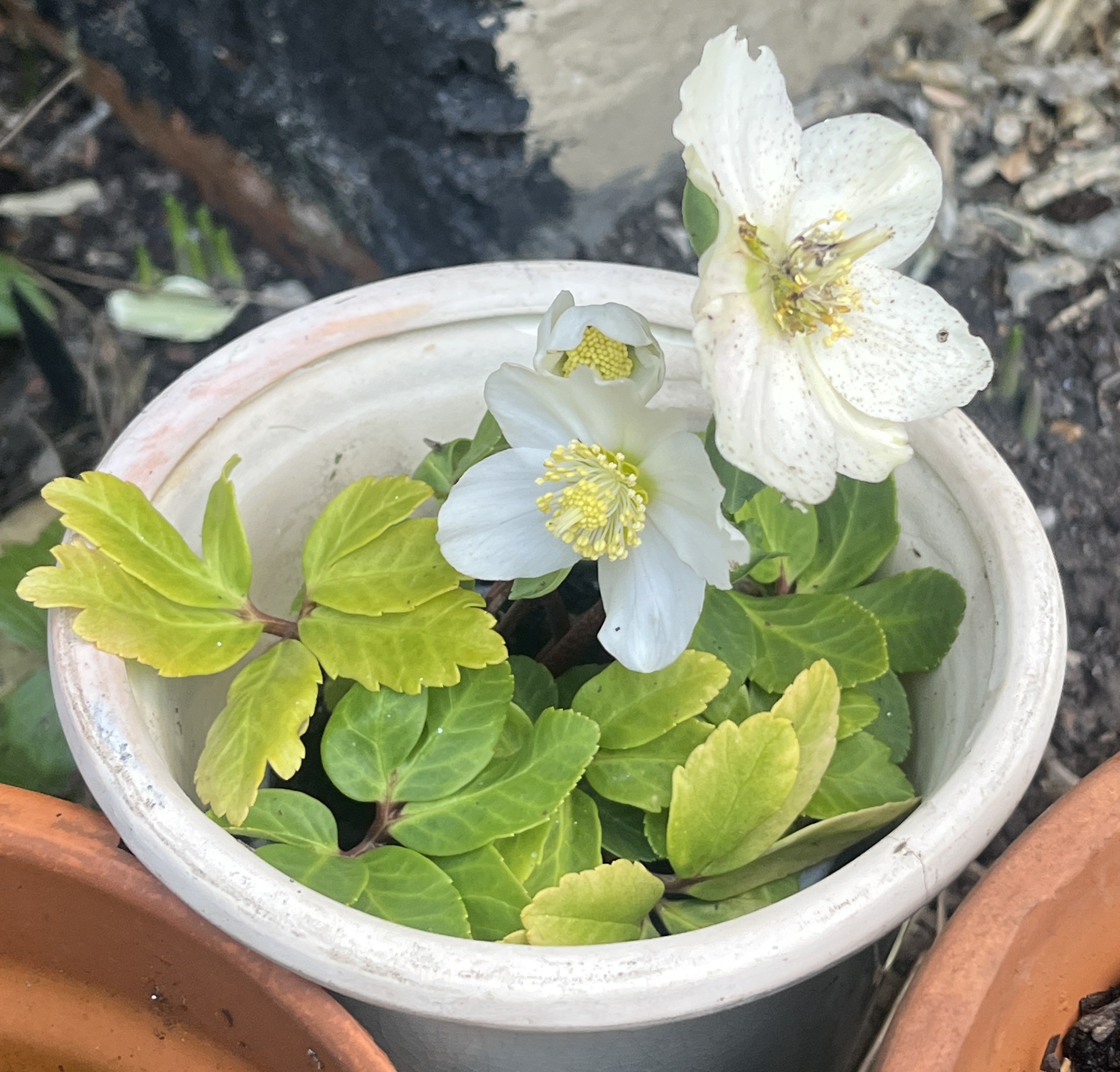
Christmas Rose, aka Helleborus Niger. My present for Mum’s garden in Suffolk.
*
You can buy Diary at the Centre of the Earth Vol 1 by clicking here.
Angela Carter’s Pasts: Allegories and Intertextualities is primarily aimed at university libraries, but can be ordered in paperback here.
*
Some other favourite things of 2025:
Novel (new): Prudence Bussey-Chamberlain’s Bone Horn (Cipher Press).
Novel (reissued): Brigid Brophy’s In Transit (Lurid Editions)
Memoir: Jodie Harsh’s You Had To Be There (Faber). The drag queen DJ whose fake name – a pun on the celebrity model Jodie Marsh – became their real name. More imitation as a way of becoming oneself.
Album: Kae Tempest’s Self Titled (Island Records). CD zine edition with printed lyrics and images.
Film: The Ballad Of Wallis Island. Seen at the Kino cinema, St Leonards-on-Sea.